


Crossing the Amazon Rainforest by Boat and Bus: The Full Slow Travel Route from Peru to Suriname
- Ilse

- 5 hours ago
- 35 min read
This guide explains exactly how to cross the Amazon by bus and boat, how long it takes and how much it costs – from Peru all the way to Suriname, travelling through Brazil and crossing French Guiana overland.
It was years ago that I first thought “how cool would it be to cross the Amazon by boat!”. At the time, I did not think it was actually possible and for some reason I had always imagined doing it in a large canoe – showing how incredibly uneducated I was with my Western education when it comes to how many people actually live and move through the Amazon rainforest.
Over the years, I learned that there are nearly 50 million people living in the Amazon basin and over five million of them live in cities such as Manaus, Belém and Iquitos. Then, last year, I saw various people on Instagram hang up their hammocks on cargo ships travelling over the Amazon River. The dream from years ago started forming into a plan…
I ended up spending nearly four weeks travelling the Amazon rainforest by boat and bus, celebrating New Year's not in Suriname but in Alter do Chão and arriving to Suriname in January 2026.
This blogpost is for anyone interested in the stories that an adventure like this can bring and for backpackers, slow travellers, adventure travellers and overlanders who are looking for practical information on how to cross the Amazon rainforest by boat – and bus where the river stops!

Content overview
Why I went from Peru to Suriname by boat and bus...
Crossing the Peruvian Amazon by Boat: From Yurimaguas to Iquitos
Fast boat from Yurimaguas to Iquitos
What does the fast route from Yurimaguas to Iquitos cost?
Slow boat from Yurimaguas to Iquitos
How much does the slow boat from Yurimaguas to Iquitos cost?
Crossing the Peruvian Amazon by Boat: From Iquitos to Santa Rosa
The fast boat between Iquitos and Santa Rosa
What does the fast boat between Iquitos and Santa Rosa cost?
The slow boat (cargo boat) between Iquitos and Santa Rosa
What does the slow boat between Iquitos and Santa Rosa cost?
The Amazon triple border (Peru, Colombia, Brazil) and whether to stay in Leticia or Tabatinga
A step by step guide to cross the Amazon triple border
Where to stay: Santa Rosa, Leticia or Tabatinga?
Practical notes on the border crossing: ATMs, currencies and scheduling
Crossing the Brazilian Amazon by Boat: Tabatinga to Manaus
The slow boat from Tabatinga to Manaus
What does the slow boat between Tabatinga and Manaus cost?
Fast boat between Tabatinga and Manaus
Crossing the Brazilian Amazon by Boat: Manaus to Santarém to Macapá
Slow boat between Manaus and Santarém
What does the slow boat between Manaus and Santarém cost?
Fast boat between Manaus and Santarém
Boats between Santarém and Santana / Macapá
How much does it cost to get from Santarém to Macapá?
What does the fast boat between Manaus and Santarém / Macapá cost?
How to Travel Overland from Brazil to Suriname via French Guiana
Border crossing between Oiapoque, Brazil and Saint-Georges, French Guiana
How much does it cost to travel through French Guiana in 24 hours?
Crossing the Border from French Guiana to Suriname (Saint-Laurent-du-Maroni to Albina)
I also have separated in-detail posts on each leg of the journey. You can navigate to my other blogposts via the menu below:
Full blogposts per leg of my journey
Why I went from Peru to Suriname by boat and bus...
I was in surf and kitesurf town Máncora in the North of Peru and had planned to spend New Year’s in Suriname. Every South American person who asked me about my plans asked “why Suriname?”or did not even know where it was. So, why did I plan to go to Suriname?

Besides my interest in visiting different places in the world, there is a special interest as my dad is married to a woman from Suriname. She has been living in the Netherlands for over 30 years and they would visit her family for New Year’s. Since I was ‘nearby’, meaning on the same continent for once, I decided to seriously plan a visit to them.
“Why not take a plane?” was a question that her entire family asked me. My answer, first and foremost, is because of the adventure. Secondly, I prefer travelling slow. It helps my energy, body and mind really settle into a place and to be transformed by it. Finally, I try to avoid planes when I can.
I had taken a ridiculous amount of flights for my studies and work in the last few months – literally crossing half the world to get from Guatemala to Bangladesh and India… So, doing the trip from Peru to Brazil to French Guiana and then Suriname over land (and water) felt like a welcome compensation of that.
...and why you should too
Especially travelling the Amazon rainforest by slow boat, has been one of my favourite travel experiences yet. The slow pace of the boat, non-stop forest view, and the consistent rhythm of the motor provided a great space for me to slow down and reflect on my life.
More importantly, however, this journey is an adventure that shows you how many people in the Amazon basin live and move – and it gives you a tiny bit of that experience for yourself. In Europe or the U.S., but even in South America itself, there is either little education or miseducation on inhabitants of the Amazon rainforest. This is your chance to speak with people, to educate yourself and hopefully to share your experience with others after.
This route is ideal for backpackers, slow travellers, adventure travellers, overlanders, and anyone wanting to cross the Amazon without flying. It requires flexibility, patience, and basic comfort with long boat journeys and changing schedules.
Route | Peru → Brazil → French Guiana → Suriname |
Total duration | 2-5 weeks |
Total price | Can be anything from 350 to 1000 EUR depending on your choices |
Cheapest route | Mostly slow boats & hitch hiking |
Most comfortable route | Alternating slow boats with fast boats and either a shared taxi or renting a car in French Guiana |
Requires Portuguese? | Definitely very helpful in Brazil, barely anyone speaks English in these areas |
Requires Spanish? | Definitely helpful, but hostels in Iquitos and Leticia usually have some English speaking staff or experience with foreigners and can often help out |
Solo travel friendly | Yes! Absolutely, you will make friends! |
Female travel friendly | Yes, but always with the standard precautions |
How to get to the Amazon in Peru
If you are starting this journey from the Peruvian coast like I did, the first challenge is simply getting into the Amazon basin itself. I began in Máncora, a surf town in the far north of Peru and honestly one of the least logical starting points for a river journey through the Amazon rainforest.
There are several ways to get to Iquitos, the largest city in the world that cannot be reached by road. Most travellers simply fly there from Lima, with multiple daily flights taking around two hours. There are also occasional direct or seasonal flights from cities such as Cusco and Tarapoto. If you are short on time, flying into Iquitos is by far the easiest option and probably the best one if your goal is primarily to explore the Amazon itself rather than the overland journey there.
For those wanting a more adventurous and overland route, there are two classic ways to reach Iquitos by river: via Yurimaguas or via Pucallpa. I chose the Yurimaguas route. From Máncora, I took buses inland toward Tarapoto and then continued by shared taxi to Yurimaguas, which is one of the main port towns connecting the Peruvian road network to the Amazon river system. From there, boats continue toward Iquitos through the Huallaga, Marañón, and Amazon rivers. The alternative route via Pucallpa is longer and generally involves even slower cargo boats, often taking four to five days to reach Iquitos.
If you are travelling through Peru before starting this route, it can actually make sense to fly domestically toward the jungle rather than returning all the way to Lima first. Many travellers combine a visit to the Amazon with places such as Cusco or Arequipa, and domestic flights to Tarapoto, Iquitos, or even Yurimaguas can save enormous amounts of time. I personally liked arriving overland because I was trying to not add to my already considerate ecological footprint due to work trips the months before. Plus, I prefer overland and slow travel as it makes the transition into different landscapes feel more gradual.
Crossing the Peruvian Amazon by Boat: From Yurimaguas to Iquitos
Yurimaguas is one of the main gateways into the Amazon river basin. Once you arrive here, your main mission will be to find the right boat that takes you further into the rainforest. There are two different options: fast or slow. The slow boat is the one you have probably heard about before; it is the one where you hang up a hammock and sleep on the decks with sometimes hundreds of other passengers and/or cargo. The fast boat is like a bus but on the water, meaning no hammocks but seats.
It is important that you need to know which boat you are looking for prior to going to the port as the ports differ per boat types. For this leg of my journey, I chose the fast route because I was writing my university papers at the time and wanted to do so in Iquitos. Moreover, I knew I was going to take slow boats later on in my journey.
Fast boat from Yurimaguas to Iquitos
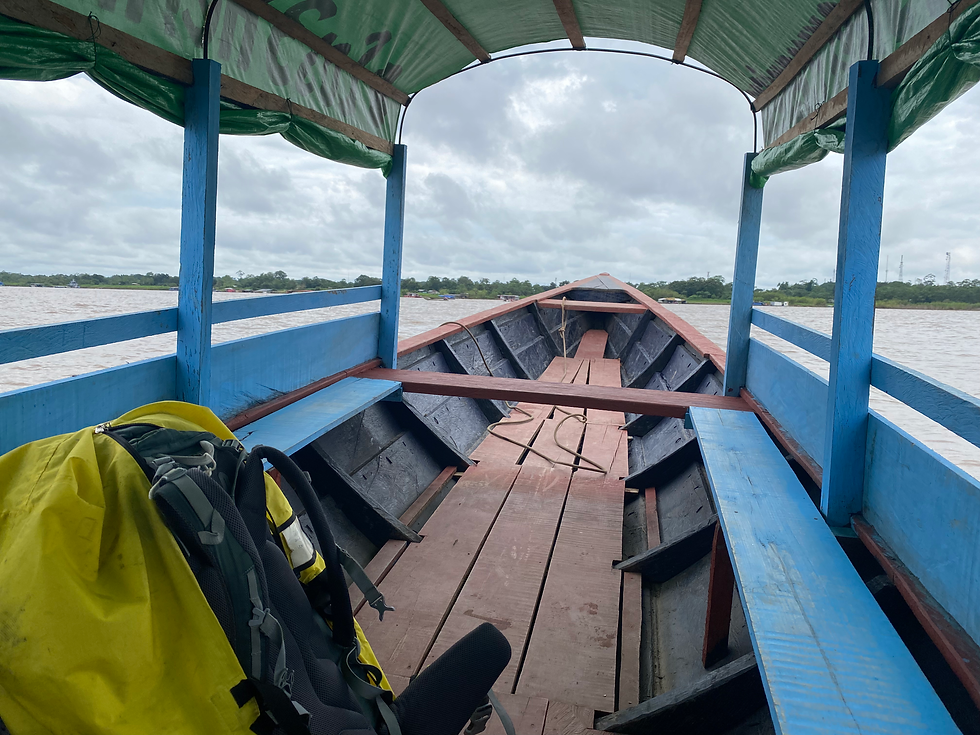
The fast boat takes you overnight to Nauta, followed by a shared taxi to Iquitos. It’s not particularly comfortable – small seats, limited leg space, people watching videos without headphones – but at the same time, you are moving through the Amazon River at sunrise, passing small riverside villages and dense forest. So, I still loved every second of it.
What surprised me was that most locals were on their phones. While my e-sim was not having connection, you could apparently connected to the internet via Starlink. I learned that this is actually a common intervention for communities in the forest that are not connected to other forms of WiFi or internet networks.
Arriving in Nauta, you will have to take a tuktuk or walk to the shared taxi station. Since I took my time getting of the boat, I ended up staying in line for hours, right behind everyone who had been on my boat. People transport everything on these taxis from luggage to furniture. I recommend trying to get off the boat somewhat quick and step towards a tuktuk driver, do not wait for them to ask you. With the shared taxi, it’s another couple of hours to Iquitos.
What does the fast route from Yurimaguas to Iquitos cost?
Boat Yurimaguas to Nauta: 200 PEN (~€50)
Shared taxi Nauta to Iquitos: 15 PEN (~€4)
TukTuk (various): ~7–10 PEN (~€2–3)
Total fast route: ~222–225 PEN (~€55–57)

Slow boat from Yurimaguas to Iquitos
If you have more time, the slow boat is a completely different experience. Make sure you ask a tuktuk driver or someone in Yurimaguas where the port for the slow boat is as this is a different one than for the fast boat.
My knowledge on the slow boat trajectory is not firsthand, but I asked a friend who has taken this option. Instead of seats, you bring your own hammock and spend 3–5 days travelling slowly along the river, sleeping among cargo and supplies. While in Brazil, this experience is structured and tailored to people, in Peru these ships are primarily cargo ships and people are allowed on them.
How much does the slow boat from Yurimaguas to Iquitos cost?
Slow boat (3–5 days, hammock + meals): 120 PEN (~€30)
Hammock: ~30 PEN (~€8)
Total slow route: ~150 PEN (~€38)
Key Takeaways (for decision-making readers)
Fast boat = ~1 day, practical, less comfortable, still scenic
Slow boat = 3–5 days, much more immersive, cheaper
Peru slow boats are different than Brazil slow boats (Peruvian ones are more cargo-like, less tailored to human passengers)
With the fast boat, you don’t go directly to Iquitos — you go via Nauta + taxi
If you are doing a longer trajectory and not wanting to take a slow boat all the time, I recommend doing it in Brazil rather than in Peru. But if you are up for a more unstructured experience, definitely try one in Peru!
Note that Iquitos itself is not necessarily where you linger unless you want to explore the jungle or work remotely for a few days, like I did. On this journey, it is your last big city in Peru before the border crossing to enter Colombia or Brazil.
If you want more detailed information, including my tips on what to bring on the boat, where to go etcetera, please read my blogpost dedicated to this specific leg of the journey.

Crossing the Peruvian Amazon by Boat: From Iquitos to Santa Rosa
The next step from Iquitos onwards, whether you flew into Iquitos or arrived from Yurimaguas as I described above, your next step will be the border crossing.
Santa Rosa is one of the main border towns in the Peruvian Amazon and is only accessible by boat from Iquitos. The river is quite literally the highway here and hundreds of people travel on it every day. Again, there are two options to travel in between Iquitos and Santa Rosa: the fast boat and the slow boat.
The fast boat between Iquitos and Santa Rosa
While I had finished one paper during some digital nomading days in Iquitos, I still had one deadline to go but was determined to get further into my journey. So, I took a fast boat to Santa Rosa in order to stay in Leticia, Colombia for some days to finish my last paper.
When taking the fast boat, there are two companies: Ferry Amazonas and Zoe Alexa. They differ significantly in price. In my full blogpost on this leg you can read where to buy tickets, with the Google Maps office locations linked and how to get to the right port etcetera.
Ferry Amazonas is the more expensive option (up to 300 PEN for foreigners), with multiple floors and supposedly slightly more space. Locals can take a cheaper lower deck, but foreigners cannot – as in foreigners are really not allowed. If you think that is unfair, remember that this boat was set up and paid by the government to enhance local transport between villages alongside the river. If you are a foreign tourist, it is not your tax money that has paid for this :)
I took Zoe Alexa, which costs 120 PEN and leaves around 5pm (you gather at 4pm). It goes every other day. Compared to my previous boat in Peru, this one was much more comfortable: more leg space, less bumpy, and I even had an entire row to lie down because it was underbooked.
Both companies say the journey takes about 12 hours, but in reality it takes longer. My boat left at 5pm and arrived around 8–9am the next morning, so about 18 hours.
The journey itself is straightforward: you sit, watch the river, stop at villages, and eventually arrive in Santa Rosa.
What does the fast boat between Iquitos and Santa Rosa cost?
TukTuk from hostel to port in Iquitos: ~5-10 PEN
Boat Iquitos to Santa Rosa (18 hours): 120-308 PEN
Snacks and meals for on the boat: 20-30 PEN
Total fast route: ~150 PEN
The slow boat (cargo boat) between Iquitos and Santa Rosa
The slow boat takes 2–3 days (48–72 hours) and costs around 100–140 PEN, usually including three simple (non-vegetarian) meals per day.
While I have not taken this boat, I met a German guy travelling the Americas with his motorbike who has. He told me that you sleep in a hammock on a shared deck with locals, cargo and sometimes animals, similar to the leg between Yurimaguas and Iquitos. You need to bring your own hammock, ropes, water and snacks. There is no fixed schedule — boats leave when they are full. It is slower, less comfortable, but definetely an adventurous experience.
What does the slow boat between Iquitos and Santa Rosa cost?
Slow boat (2–3 days, hammock + meals): 120 PEN
Hammock if you did not have one yet: ~30 PEN
Total slow route: ~100-170 PEN
Key Takeaways (for decision-making readers)
Fast boat = ~1 day, practical, less comfortable, still hours of watching the rainforest
Slow boat = 2–3 days, much more immersive, cheaper
Peru slow boats are different than Brazil slow boats (Peruvian ones are more cargo-like, less tailored to human passengers)
Same as I said above, which boat you will want to take depends on your wishes as a traveller and the time you have. If you are doubting between whether to take a slow boat in Brazil or Peru, I would recommend Brazil as it is much more set up for human passengers, which makes it much easier to navigate. However, both will be an adventure!

The Amazon triple border (Peru, Colombia, Brazil) and whether to stay in Leticia or Tabatinga
The three border towns are Santa Rosa in Peru, Leticia in Colombia, and Tabatinga in Brazil. Leticia and Tabatinga are connected by land and to get there from Santa Rosa you will need to take a boat. Crossing the border here is relatively simple, but it does require a few steps and things to look out for.
For Peru to Brazil and/or Colombia the process is as follows. If you go the other way around, just follow the steps the other way around.
A step by step guide to cross the Amazon triple border
Step 1 – Stamp out of Peru
When you arrive in Santa Rosa, do NOT follow the crowd straight to the boats. Most locals stay within the 80 km border zone and don’t need stamps, but if you are continuing your journey, you do.
The immigration office is about a 10-minute walk from the port, locals will be able to point you the way if you do not have internet connection for Google Maps. You stamp out there first. If you overstayed your visa, you pay a fine — which is 5 PEN per day. The immigration officer will tell you where to pay this, while I was there it was right next door at a hotel.
Step 2 – Boat to Leticia (Colombia)
After stamping out, you take a small boat across the river to Leticia. This takes about 10 minutes and costs anything between 5–10 PEN per person. If they ask much higher, just say you will look around a bit further and they will probably lower their price. You can also say that earlier you were charged lower. You don’t need to arrange this boat in advance — boats are constantly going back and forth.
Step 3 – Enter Colombia or Brazil
From Leticia, you have two options: stay in Colombia and stamp in there, or as I did, go straight to Tabatinga, Brazil and stamp in there. Leticia and Tabatinga are connected by road so you can simply cross by land. Important to remember is that you must stamp into your next country within 24 hours. The Brazilian Federal Police (for entry stamps) closes around 12–2pm.
The Colombian immigration office that is normally right at the port in Leticia was closed for renovations while I was there (in December 2025), so people had to go to the immigration office at the airport.
Where to stay: Santa Rosa, Leticia or Tabatinga?
If you are preparing this journey or arriving at the border-crossing soon, you might wonder where to stay. While these towns are literally only meters away from each other, the differences in accomodation, prices, and safety are big.
Santa Rosa, Peru is very small and has no hostels, only relatively expensive hotels. Not worth staying unless you really want to.
Leticia, Colombia is much larger and in my opinion the best option, I stayed in a lovely hostel here. There are various hostels, a larger market, more cafés, a museum, and it is overall a nicer place to stay for a few days. I stayed here for a few days to rest after the journey, organise my next boat and most importantly in my case to get some work done.
Tabatinga, Brazil is more of a functional border town. Fewer nice places to stay and less atmosphere. Many people go here for shopping. If you are travelling further into Brazil, you will likely still go here for the immigration office to get the Brazil entry stamp, to go to an ATM to withdraw Brazilian reais, and to arrange your next boat from Tabatinga. However, there is no need to stay here overnight as everything is a simple motorbike or walk away from Leticia.
Practical notes on the border crossing: ATMs, currencies and scheduling
There are no reliable ATMs in Santa Rosa, so make sure that you withdraw some cash in Iquitos, specifically if you need to pay a fine for overstaying your visa like I did. Again, this costs 5 PEN per overstayed day. I believe you can pay by card as well, but you will be charged extra.
When it comes to money in Colombia and Brazil, Colombian pesos and Brazilian reais are accepted in both places, although exchange rates might not be as favorable if it is calculated per transaction. Since I stayed in Leticia only a few days and needed reais anyway for my trip later, I decided to just take out reais, pay everything in Leticia by card, and accept the higher exchange rate on the handful transactions that I did in cash with reais in Leticia. Do make sure that you spend Peruvian soles before leaving because they are not accepted here.
This border crossing is quick in theory (a few hours), but it’s also a natural pause point in the journey, especially when you have to wait for the next boat from Tabatinga to leave. So I recommend staying in Leticia for some days.
Crossing the Brazilian Amazon by Boat: Tabatinga to Manaus
Travelling from Tabatinga to Manaus was probably my favourite part of the journey. It was the only stretch where I took a slow boat and slept in a hammock for several days, spending hours just watching the forest go by and imagining the life in the forest that always continues.
As with the other parts of crossing the Amazon, there are two options: a fast boat or a slow boat. The fast boat is more expensive (around 900 BRL), feels more like a plane or bus, and arrives the next day.
The slow boat from Tabatinga to Manaus
The slow boat takes three nights and four days, costs around 120 BRL (including three meals per day), and gives you the experience that you have were curious about when first hearing about crossing the Amazon rainforest by boat. You sleep in a hammock next to hundreds of other passengers — mostly Brazilian families and Indigenous travellers, plus a few backpackers.
Schedules and buying tickets
Whether you are taking the fast or slow boat, you can either buy your tickets at the port in Tabatinga or online. It was only through a Brazilian that I met in Alter do Chão later on my boat journey that I learned there is an online platform that shows the schedules of all the slow and fast boats (across companies) in Brazil: yjaraviagens.com. This is also where you can buy tickets online.
Note that the platform is not really made for foreigners when it comes to payments, so you might have issues with creditcard if it is not Brazilian or if you do not have the Brazilian payment method Pix . However, it is a great place to check schedules and know which boat companies to contact directly to buy tickets.
Boats do not go every day, so you might have to wait in Tabatinga or Leticia for a few days. I bought my tickets two days in advance at the port, but many people buy it on the same day.
Like I wrote above, Tabatinga itself is not really a place to stay. Instead, I recommend staying in Leticia, Colombia. No need to stamp into Colombia for that stay as there is an 80 km free border zone. Simply take a Tuktuk from your hostel in Leticia to the port in Tabatinga on the day you leave.

Departure
The slow boat and fast boat seem to depart from the same port, but note that the information below is based on my experience with the slow boat.
On the day of departure, I arrived to the port around 9am, three hours before the boat was scheduled to leave. I think you can easily arrive at 10 or 10h30 without stress. Passengers will begin forming lines with their bags, so you might not be in the front of the line when you arrive later, but I found that locals choose different hammock spots anyway. More on that in my more detailed post on this leg!
Regardless of whether you have bought a ticket in advance, you will need to get a wristband before boarding. The long line you will see is for buying a ticket, so if you already have a ticket just walk up to the desk and ask for the wristband.
The doors to the boat opened around 12 and it left quite soon after everyone was on there and had set up their hammocks. People on the decks will be able to help you hang up your hammock if you do not know how to tie the ropes.

On the boat
The slow boat takes three nights and you sleep in a hammock that you bring yourself. I had already bought my hammock earlier in Yurimaguas (30 PEN) and bought ropes in Leticia. I bought ropes again at the port in Tabatinga just because I was afraid the ones I bought in Leticia would be too short.
The slow boat itself is surprisingly comfortable and I adored sleeping in the hammock. There is electricity, bathrooms, and showers, and basic food is included. I spent most of the time looking at the forest, reading, journalling, listening to music, and talking to people. I had met two other backpackers at the queue, Daniel from Mexico and Leoni from Germany, and we had decided to hang our hammocks next to each other.
On the first night, there was a thunderstorm that was cinematic — lightning shooting through the sky while we watched from the covered rooftop, excitedly screaming each time a bolt lit up the trees. It was one of the most memorable moments of the entire trip.
The best hammock spot
The best hammock spots are usually on the second floor, away from toilets, kitchens, and the motor, though it may depend on the size of the boat. My new friends and I ended up at the front on the “window” side, which was quiet and had almost no people passing by. Again, for a more exact explanation on choosing the best hammock spot, I refer you to my much more elaborate post on the journey from Tabatinga to Manaus.
Safety on the boat
Even with the few storms during the journey, I always felt safe. I kept my passport and phone with me at night and my backpack above my head. Leonie attached her bag to her hammock for extra security, but overall, the atmosphere was friendly and relaxed.
Food on the boat
Food on the boat is basic but sufficient, although as a vegetarian you might want to bring some extra snacks. Breakfast includes fruit, bread, and a sweet oats mixture, while lunch and dinner are usually rice, beans, pasta, and chicken or fish.
Meals run out quickly, so it’s best to queue early, especially if you want vegetarian options. I bought eggs on the boat to supplement my protein (beans were prepared with meat) and brought snacks like fruit, nuts, and muesli bars.
Drinks are mostly sweetened juice or coffee, and there is potable water onboard. Vendors occasionally come by selling ice cream, mango, or açaí, all in cash.
Internet and electricity
Internet on the boat is limited. Near towns, you can sometimes catch a signal with a local SIM card or e-sim (which I got), and the boat offers WiFi for around 70 BRL for the three days, but it is unreliable. Plus, you might prefer to unplug completely these days.
Charging devices is possible via limited plugs, often requiring an extension cord if you want to keep your phone safe and out of the way. We made friends with our neighbors who had such an extension chord and regularly had our phones in their backpacks charging, showing how friendly the atmosphere was and how safe we felt.
I chose to spend the three days mostly offline, enjoying the forest and the company of the people I met.
What does the slow boat between Tabatinga and Manaus cost?
Boat ticket: 120 BRL (3 meals per day included)
Hammock: ~30 BRL
Ropes: ~10–20 BRL
Snacks + extras: ~70 BRL
Total: ~200 BRL (~€30) for 3 nights / 4 days

Fast boat between Tabatinga and Manaus
Alternatively, you can take a fast boat between Tabatinga and Manaus. I do not have firsthand experience with this one, nor have I heard from anyone that they have taken it. It seems that the boat leaves from the same port in Tabatinga as the slow boat.
The website I have mentioned various times by now shows the schedules and prices for the fast boats as well as the slow boats. I have asked about the fast boat and they told me that it costs 900 BRL and arrives the next day.
From my experience with the other fast boats I took in Brazil, see Manaus to Santarém and Santarém to Macapá, the fast boats in Brazil are much more luxurious than the ones I took in Peru.
What does the fast boat between Tabatinga and Manaus cost?
Fast boat: ~900 BRL
Food and snacks: ~50 BRL
Total: ~950 BRL for 1 night / <2 days

Arrival in Manaus
We arrived in Manaus after about three nights on the slow boat, slightly delayed, around 5 pm. After days of only seeing forest and small towns, arriving in Manaus was intense. The city has two million people and a huge harbour that is very polluted. The water was unfortunately littered with trash, a stark contrast to the pristine rivers we had been floating past – even though we also saw one of the employees of the boat sweep the floors and dump everything into the river directly, right next to the sign that says 'do not litter in the river'.
Manaus is more interesting than Tabatinga, with museums and cultural activities where you can learn about the state’s history and Indigenous cultures. That said, the neighborhoods near the port show poverty and some drug abuse, so it is safest to get around by Uber, especially after dark.
After arriving in Manaus from Tabatinga, we right away headed to the fast boat port to buy tickets for our next boat as we would not be staying in Manaus. The slow boat ticket offices are at the same place as where you arrive in the slow boat, just follow the crowds off the deck and past a parking lot of cars. There is a building with various ticket offices inside.

Since we wanted to take a fast boat, we would have to go to a different port to buy our tickets. The fast boats go from 'Porto Amarelo' or 'Balsa Amarela', which is a yellow floating building. Walking from the port, we ignored a local who tried to convince us to pay 50 BRL for a shortcut to the fast boat ticket office and instead strolled the 10–15 minutes ourselves.
In terms of safety, Manaus reminded me a lot of Salvador da Bahia, meaning there are various parts such as the city seemed perfectly fine and other parts that felt more sketchy, especially after dark. As soon as it got dark, we relied on Uber rather than walking and after buying our tickets (in cash) at Porto Amarelo we spent just half a night at a nearby hotel before our next departure.
Crossing the Brazilian Amazon by Boat: Manaus to Santarém to Macapá
The fast boats from Manaus to Santarém leave from Porto Amarelo, a yellow floating building. We bought our tickets there as soon as we arrived by slow boat from Tabatinga and scheduled our trip for the next early morning. Several days after I went from Santarém to Santana / Macapá.
Again, for both of these stretches there are two boat options: a fast boat and a slow boat. Together with my new friend Leonie, I chose the fast boat for from Manaus to Santarém, mostly because we wanted to arrive in Alter do Chão for New Year’s Eve and we arrived on the 29th. I also chose the fast boat from Santarém to Santana and Macapá because I wanted to visit my family in Suriname and was already much later than planned. Below I give info on both the fast and slow boats.
Slow boat between Manaus and Santarém
The slow boat is similar to the one between Tabatinga and Manaus. If I had more time, I would have definitely taken the slow boat as I think it offers a more immersive experience of the Amazon, similar to my journey from Tabatinga to Manaus.
This slow boat takes 30 to 36 hours, meaning one night and two days and costs around 220 BRL. From what I have heard from other travellers that I met in Alter do Chão who had taken this boat, it is much smaller than the one between Tabatinga and Manaus. They described about 30 hammocks being on each floor, which is very different from the estimated 300 I counted on ours.
You can book tickets either via the slow boat office in Manaus, which is also the port that the slow boats arrive and leave from. You can look at schedules and prices on this website. You can also book online but might run into payment issues if they ask for a Brazilian CPF when filling out credit card information or via Pix .
What does the slow boat between Manaus and Santarém cost?
Slow boat: ~220 BRL
Food and snacks: ~20 BRL
Total: ~240 BRL for 1 night / <2 days
Fast boat between Manaus and Santarém
Our fast boat from Manaus to Santarém was called the Anna Karolina. It left at 4 am and we were instructed to really be at the port at 3 am. We took an uber from our hotel in Manaus. Despite the port being in a slightly sketchy location, with people camping right next to it on the beach, the market was already starting up so it felt safe to walk there as there was plenty of movement going on.
The boat itself was super comfortable and much more luxurious than the ones I took in Peru. This one was almost like a small plane with reclining seats and tables, but more legroom than economy class in a plane. I even managed to do some work during the ride, and my friend and I each got a row to ourselves, which allowed for a few extra hours of sleep (laying flat).
Early in the morning, the air conditioning was strong, so a jacket and socks were necessary, but we could later remove layers as the temperature rose with the light of day. Coffee was free, and meals and snacks could be purchased onboard. Vendors also came through the boat selling fruit or açaí, paid either through Pix or in cash.
We arrived in Santarém later than planned, around 11 pm. Luckily, Leonie's friend had planned a shuttle for us which picked us up at the port and took us to Alter do Chão, which is about an hour away. The ride cost 150 BRL for the two of us.
My bus back to Santarém later was only 10 BRL but ran only during the day. Staying in Santarém for a night is another option if you want to explore or save money, and there are decent hotels if you choose carefully.
What does the fast boat between Manaus and Santarém cost?
Fast boat: ~900 BRL
Food and snacks: ~50 BRL
Total: ~950 BRL for 1 night

Boat between Santarém and Santana / Macapá
Continuing north from Santarém toward Macapá, I took a fast boat from Santarém to Santana. Again, you can choose between slow and fast boats.
The slow boat takes roughly 30 hours, leaving in the evening and including a night in a hammock, while the fast boat takes about 12–15 hours and is more expensive. I chose the fast boat due to time constraints and arriving for family plans in Suriname. The ticket cost me 518 BRL, and lunch on board was 30 BRL. Breakfast could also be purchased, but I made my own oats. Unlike some other fast boats, coffee was not included on this ride.
On the fast boat, I met a Brazilian father and son who had lived in French Guiana. We shared an Uber from Santana to Macapá, which cost 50 BRL total, and I paid half. In Santana, all bags are called out by number for pickup, so it’s important to keep track of your own. This ride marked the end of my Brazilian river crossings; after Macapá, only the route from French Guiana to Suriname remained.
On these fast boats, comfort is surprisingly good. Seats are spacious, plugs are available under each seat, and WiFi can be purchased for a day, though coverage is unreliable. Meals are mostly rice, beans, pasta, and chicken, though you can often ask for a vegetarian version or supplement with your own snacks. As with the previous stretches, it’s best to plan ahead for tickets and keep some flexibility in case of delays.
With my e-sim, I had cell service at various points along the way, primarily when we were near a city. I usually get my e-sims from Airalo, you can use my friend code ILSE8196 to get a 3 EUR discount on your first purchase there!
How much does it cost to get from Santarém to the bus station in Macapá?
For the slow boat:
Slow boat ticket: 309 BRL, which you can see via this website.
Food is included
Shared Uber from Santana to Macapá: 50 BRL of which I paid 25 BRL
Total: 334 BRL
For the fast boat:
Fast boat ticket: 518 BRL
Lunch on board: 30 BRL
Breakfast on board: 20 BRL (I did not pay this as I made my own oats)
Shared Uber from Santana to Macapá: 50 BRL of which I paid 25 BRL
Total I paid: 575 BRL
Boats between Santarém and Belém or Manaus and Belém
Rather than going to Santana, many people go to Belém or come from Belém into Santarém or Manaus. I have not taken this trip but have met a few people talk about it. The slow boat seems to be similar to my experience from Tabatinga to Manaus. For information on tickets and scheduling, I refer to the same website as I gave above.
From what I have seen, the slow boat in between Manaus and Belém stops in Santarém and so the boats for both journeys are the same. Between Belém and Santarém the slow boat takes around 45 hours and costs about 300 BRL. It goes only once a week and leaves on Fridays from Santarém to Belém and on Thursdays from Belém to Santarém.
The journey from Manaus to Belém takes 115 hours, making it the longest slow boat in the Brazilian Amazon. The one that stops in Santarém leaves from Belém on Thursdays (and is the same one as above), but there is also one that does not stop in Santarém is slightly faster with 96 hours and leaves from Belém on Tuesdays. Both cost 450 BRL.
The boat the other way around, so from Manaus to Belém, leaves on Thursday and takes 91 hours. I did not find a second day, but this might depend on the week, so check the website. Note that the estimated duration has never been correct for me, so as with everything on this journey: do not plan tightly.
There seem to be no fast boats available, at least not on the only booking platform that I found over my whole journey (note that this is not a sponsored link, it genuinely is the only platform my Brazilian friends and I have found). But you migth be able to ask around in Belém or Manaus itself.
How to Travel Overland from Brazil to Suriname via French Guiana
While Santana was the last stop on my boat journey, my journey through the rainforest continued. I travelled through French Guiana to Suriname, from which you can continue your journey to Guyana if you want. Below, I describe this part of my journey quickly, but if you are actually about to go on this journey and want detailed information, please read my much longer blogpost here.
Note that if you are flying into South America to do this journey, if you are flying from Europe to the Guianas (typically around 600 EUR) or northern Brazil, flights to Cayenne can sometimes be significantly cheaper than for example flights to Paramaribo (typically around 1000 EUR retour).
Bus from Macapá to Oiapoque
From Macapá I travelled to the most northern city in Brazil, Oiapoque, per night bus for 260 BRL. All buses go overnight and there is only bus company. I booked my tickets via the Brazilian platform Buson with my friend's Pix , but I later realized that you can also buy a ticket via Busbud. The bus is definitely the cheapest option. Your other options are shuttles, which charge between 400 and 500 BRL, or hitch hiking which can take long in this area.
--> Read more about the different options in my full blogpost on this leg.
Border crossing between Oiapoque, Brazil and Saint-Georges, French Guiana
From the bus station in Oiapoque, a short taxi took me to the border post, where you have to remember to stamp your passport leaving Brazil - something easy to miss as many frequent crossers do not need to do so. This taxi ride cost me about 60 BRL. Entering French Guiana was smooth with a European passport, but I made sure my e-sim was ready for navigation and communication, as data costs are high once inside the EU territory.
In terms of food, in Oiapoque at the bus station there is not much (definitely nothing vegetarian or unfried) and I did not see a supermarket nearby. If you travel light or are with multiple people, you can consider going to a supermarket or restaurants to find some food to bring to French Guiana to save money when you are there. I travelled alone and with a heavy backpack, so I just accepted my loss when I paid 9 EUR for a wrap and 3 EUR for a juice in French Guiana.
--> Read more about the border crossing and my tips in my full blogpost on this leg.

French Guiana
The change from Brazil to French Guiana is striking. Although it is geographically part of South America, legally it’s France: euros, French infrastructure, French law, Schengen rules. Yet the reality is anything but French. There is dense rainforest and the mixture of cultures and languages is striking - Indigenous peoples, Creoles, Brazilians, Surinamese, Hmong communities, and metropolitan French all live side by side. Languages alternate and include Portuguese, French, Dutch, Sranan Tongo, and English.
At the border, I opted for a “navette” shared taxi to Cayenne and from Cayenne to Saint-Laurent-du-Maroni (each cost 50 EUR and no negotiation possible, this is the local price). On the way from Saint-Georges to Cayenne we made one stop where you could get some food, with vegetarian options and fresh juices. On the way from Cayenne to Saint-Laurent-du-Maroni we stopped at a local night market where I got some fried snacks.
The taxis were much slower than I (or anyone in my taxi) had planned and I ended up staying one night outside Saint-Laurent-du-Maroni with a Couchsurfing host instead of crossing the next border in the same day.
At my Couchsurf place, my hammock came in handy once again, and I enjoyed a night in the rainforest and away from the main road. Prices are higher than in Brazil, so budgeting snacks and planning transport in advance is wise.
--> Again, a much more detailed overview of this leg of my journey is in the separate blogpost.
How much does it cost to travel through French Guiana in 24 hours?
Overnight bus Macapá → Oiapoque: 260 BRL (~50 EUR)
Taxi Oiapoque → Border: ~60 BRL (~12 EUR)
Shared taxi Saint-George → Cayenne: 50 EUR
Shared taxi Cayenne → Saint-Laurent-du-Maroni: 50 EUR
Couchsurfing Saint-Laurent: free (hammock spot)
Food & snacks (rough estimate for French Guiana): 10–15 EUR per meal at roadside cafés
Total: 175 EUR (unless you hitch hike!)
Crossing the Border from French Guiana to Suriname (Saint-Laurent-du-Maroni to Albina)
After a night with a Couchsurf host, I crossed the Maroni River in the morning from Saint-Laurent-du-Maroni, the main border town on the French Guiana side. The official ferry runs between 8am and 6pm and takes about ten minutes, costing roughly 4 EUR per person.
Local wooden boats - referred to as “bootmannetjes”in Dutch - also leave whenever full for a similar price, though the ferry is generally more straightforward for passport control. Even without a physical entry stamp in French Guiana, the border police record your details, so make sure to stop at the office before boarding to avoid complications.
Once you've crossed you arrive in Albina, Suriname, where you will straight away go to the immigration office. The ferry arrives at the immigration office. If you go with the local wooden boats the process might be different. I have heard that they sometimes take your passport on the river and take it to the office and bring it back to you, or you have to walk to the immigration office yourself. Considering you need a signed e-form and in some cases a visa, I think it is best to walk there yourself. The giving your passport away on the boat might only work for people with Suriname passports. For more details on the border crossing, please go to my post on Crossing French Guiana.
After my documents had been checked and my passport approved for entry, I caught a shared taxi from Albina for the two-hour ride to Paramaribo for 25 EUR, finishing the overland and river journey I had started all the way in Peru. After weeks of slow and fast boats, night buses, and multiple border crossings, arriving in Paramaribo marked an emotional end to a wonderful journey - one with lots of delays, unexpected connections, more money spent than planned, but everything 100% worth it.
What does it cost to travel cross the border from Saint-Laurent-du-Maroni, French Guiana to Albina, Suriname?
Ferry Saint-Laurent → Albina: 4–5 EUR
Shared taxi Albina → Paramaribo: 25 EUR
Total: 30 EUR

FAQs: Total Cost, Duration, and Practical Tips
How long does it take to cross the Amazon from Peru to Suriname by boat and bus?
The duration depends entirely on whether you choose fast boats or slow cargo boats. If you travel mostly by fast boat and move quickly through border towns, the journey can technically be completed in around 10–14 days. If you choose slow boats and spend time in places such as Leticia, Manaus, or Alter do Chão, it can easily take 3–5 weeks.
Keep in mind that schedules throughout the Amazon are flexible and delays are common due to weather, river conditions, and boat logistics. So, I strongly recommend not planning this journey too tightly. I initially did plan very tightly and in the end happily accepted taking a full week longer.
How much does it cost to cross the Amazon from Peru to Suriname?
The total cost depends heavily on whether you choose fast boats or slow boats - and on whether you are doing to full journey. Particularly French Guiana is expensive, so not going all the way to Suriname but staying in Brazil, or hitch hiking instead of taking shared taxis, will cut your costs massively.
Approximate transport costs without hostel accommodation:
Mostly slow boats: ~€350–500
Mostly fast boats: ~€900–1400
Mixed route (what I personally did): ~€700–1000
These estimates include:
boats
buses
border crossings
taxis between ports
basic food/snacks on travel days
They do not include:
accommodation
tours
nightlife
visas
travel insurance
flights to or from South America
Again, French Guiana is by far the most expensive part of the route and cost me over 150 EUR. Per heading in this blogpost, I have added the costs for that leg of the journey for both the slow boat and the fast boat option.
Is it safe to cross the Amazon by boat?
In my personal experience, yes, absolutely! I travelled both alone and with people I met along the way and generally felt safe throughout the journey.
The slow boats in Brazil especially had a surprisingly relaxed and communal atmosphere. People shared food, helped each other hang hammocks, and looked out for each other.
That said, normal travel precautions still apply:
keep valuables with you at night
avoid flashing expensive electronics
use official border crossings
avoid walking alone late at night in port areas of larger cities like Manaus
Is this journey possible without speaking Portuguese or Spanish?
Yes, it always it, but it helps enormously to know basic Spanish and Portuguese. In Peru and Colombia, Spanish is very useful. In Brazil, many people in the Amazon region do not speak English. Even basic Portuguese phrases will make transport, food, and ticket buying much easier. Google Translate offline mode helped me constantly throughout the trip, or make a friend that speaks one of these languages!
Oh, also do not expect that the Brazilians will understand your Spanish, sometimes they do, sometimes they do not. For many people in this region, Portuguese is already their second language as there are countless Indigenous languages spoken here.
What is the best slow boat in the Amazon?
For me, the slow boat from Tabatinga to Manaus was by far the highlight of the journey. The boat is large, relatively organized, and designed for passengers sleeping in hammocks. The atmosphere was social, safe, and surprisingly comfortable. Watching the rainforest pass by for four days became one of my favourite travel experiences ever.
I have not taken the other slow boats myself, but based on the various conversations I have had with other travellers, I can say that the Brazilian slow boats seem to be the best adapted for hammock-travellers. The Peruvian ones are usually cargo ships where hammocks are allowed.
What should you bring on an Amazon slow boat?
I am working on a full packing list for this, but essentials include:
hammock (you can buy this in any of the port cities for a few EUR)
hammock ropes (buy with the hammock or at the port itself for a few EUR)
power bank (I did not bring this and survived fine, but especially if you travel alone this can be good)
toilet paper (they run out quickly)
snacks
water bottle (there is filtered water on the boat)
earplugs
eye mask (the lights turn on at stops in the middle of the night...!)
sweater or blanket for air conditioning (in fast boats)
offline maps
dry bags for electronics (just to avoid drops of water causing damage)
extension cord if possible
Vegetarians especially should bring extra snacks and protein sources, I brought oats and a bunch of nuts.
Can you cross the Amazon completely by boat?
No, not entirely. While huge sections of the journey happen on the river, there are still overland stretches:
Nauta → Iquitos
Leticia ↔ Tabatinga
Macapá → Oiapoque
French Guiana crossings
Albina → Paramaribo
Still, the majority of the route follows the Amazon river system.

Final Thoughts on Crossing the Amazon by Boat
Crossing the Amazon by boat ended up becoming one of my best travel memories of over six years total of slow travel. What I liked most is that the journey forced me to slow down and helped me to log off for some days. I really had to surrender into delays being okay and trusting that I would find accommodation sometimes.
This route also taught me a lot about city life in the Amazon. While I had been with the Yawanawá in Acre, Brazil before and while I had done a tour in the Cuyabeno forest in Ecuador, I had never experienced such large and thriving cities so deep into the forest!
Manaus was especially striking in this sense. The river there really is part of infrastructure, movement, economy, family connection, and daily routines - and unfortunately very polluted. That is perhaps what made this journey so special to me: it really felt like I was briefly participating in the ways people already move through the Amazon on a daily basis.
When I looked for info on how to undertake this journey, there were very little sources available – huge thanks to the travel blogs Anna Around the World and Maho on Earth who gave me the most complete overviews of this journey before embarking on it myself. If you are considering doing this route yourself, I hope this guide helps make the journey feel more possible, practical, and less intimidating than it first seemed to me years ago.
And if you do end up crossing the Amazon by boat one day, feel free to send me a message — I would genuinely love to hear your story too.
If you want to stay updated on posts about life as a digital nomad, destination guides for digital nomads, and other slow travel related articles, you are super welcome to subscribe to my newsletter or follow me on Instagram!


Comments