


From Tabatinga to Manaus by Boat - Crossing the Amazon Rainforest
- Ilse
- Jan 26
- 20 min read
Updated: Mar 7
Have you ever wondered whether it is possible to cross the entire Amazon rainforest by boat? It turns out that that is not such a crazy idea. Hundreds of Indigenous people and other nationals in Brazil, Colombia, and Peru do so every week. And unlike you might be inclined to think with the limited media representation we get outside of Latin America about the Amazon rainforest, such a crossing does not happen per canoe. From large cargo ships where hundreds of people hang up their hammock for a few days to fast boats that are as luxurious as a plane: there are various ways to cross the Amazon rainforest by boat.

I have crossed the rainforest by boat and bus from Yurimaguas, Peru all the way to Paramaribo, Suriname, passing through Colombia, Brazil, and French Guiana. Since there are only a few travel blogs out there describing this journey in detail, I have done my best to gather all the information you might seek when trying to do this journey – or at least this is the information that I would have liked to have beforehand.
In the series 'Crossing the Amazon rainforest by boat and bus,' I describe the entire journey in detail, answering questions like what it costs to cross the Amazon rainforest by boat, how long it takes, what the boats look like, and whether you have to buy bus and boat tickets in advance. For sake of length and search purposes, I have divided the journey into various post. In this post, you will read all about the journey by boat from Tabatinga to Manaus, Brazil.
Contents of this post
How to get from Tabatinga to Manaus, Brazil?
My slow boat journey from Tabatinga to Manaus
The people that made this boat trip unforgettable
Other posts in this series
Crossing the Amazon Rainforest by Boat (overview post from Peru to Suriname)
How to get from Máncora to Yurimaguas, Peru
Travel by boat from Manaus (AM) to Santarém (PA) to Macapá (AP), Brazil
How do the border crossing to French Guiana and travel all the way to Suriname over land
If they are not linked yet, that means I am still writing them. I will publish them from January through March in 2026. Sign up for my newsletter to get notified!

How to get from Tabatinga to Manaus, Brazil?
The travel from Tabatinga to Manaus was probably my favourite part of this journey! It was the only part in my journey in which I took a slow boat and thus slept in a hammock, seeing mostly forest for several days.
As with the other parts of my boat journey crossing the Amazon rainforest, however, there are two ways to travel from Tabatinga to Manaus by boat: the fast boat and the slow boat.
What is the difference between the slow boat and the fast boat between Tabatinga and Manaus (or the other way around)?
In short, the fast boat is more expensive – this one is 900 BRL –, has the feeling of a plane or bus and arrives the next day. The slow boat is (shocker) slower and takes three nights to arrive, it is cheaper – this one is 120 BRL with three meals included – and in my opinion by far the more adventurous one.
On the slow boat, you sleep in a hammock that you have to bring yourself next to hundreds of other passengers. These passengers consist mostly of Indigenous families and other Brazilians living in this area travelling between cities and villages, but you will likely also find a handful of travellers like me.
The boats do not go every day and it is difficult to find accurate schedules online in advance. I have even asked various boat companies in Iquitos, for example, and they also had no idea. So, the best is just to arrive and not be in a rush and accept that you might have to wait a few days around Tabatinga before getting on the boat.

Where is Tabatinga and is worth to visit?
Tabatinga is one of the three towns on the three country border with Brazil, Colombia and Peru and is located in the interior of the Brazilian state Amazonas. Although surely every place has its value, Tabatinga itself is not a place I would recommend travelling to for the sake of seeing Tabatinga. With the city being a cross-border trade point, it is mostly the place where people come to make certain purchases or to take a boat to Manaus, Brazil or any place on the way.
I had come from Peru and instead of staying in Tabatinga until the boat would leave, I stayed just across the border in Leticia, Colombia. Leticia has a slightly nicer center where you can explore restaurants, markets, and a museum by foot. From what I heard in Leticia, Tabatinga is also slightly more dangerous, but I am not sure how much of that is just the grass is more dangerous on the other side.
Since there is an 80km range of free travel of persons and goods in this border area, you can be stamped in to either one of these three countries but stay elsewhere. Tabatinga and Leticia are right next to each other and connected by road. You can get to Santa Rosa, Peru from Leticia per small boats. You can read more about that border crossing in my other upcoming blogpost, but in any case it is good to know that if you are travelling from Tabatinga to Manaus and staying in the area for a few days, it is the most convenient to be be stamped into Brazil right away and to stay in Leticia (I stayed in La Jangada Eco Hostel in Leticia). Santa Rosa, besides being small and only having expensive hotels, is inconvenient because of the river.

Where is Manaus, Brazil and is it worth to visit?
Manaus is the capital of the Brazilian state Amazonas and is considered the state's economic and cultural center. It is also the seventh largest city in Brazil and counts two million inhabitants – from my Dutch perspective specifically, a gigantic city.
When we – we because I made friends on the boat – arrived per slow boat in the harbor of Manaus after seeing only forest and small to large towns for days, I was flabbergasted by the size of Manaus and its harbour. There was also a shocking amount of trash in the water, leaving me feel quite hopeless about all the cans and plastic cups that I had tried to save from flying from the trash bins on the boat into the river water earlier on the journey.
Manaus is definitely more interesting to visit than Tabatinga. Being considered the cultural center of Amazonas, it has museums and various cultural activities to learn more about the state's history and the variety of Indigenous cultures.
Hover, from my very brief impression of a limited area of the city, I was super happy to leave within a few hours to take my next boat. In the neighbourhoods around the harbours, unfortunately, there is a lot of poverty and drug abuse. These areas are generally not considered safe to walk at night, whether with a group of by yourself. So best to move around with Uber.
To give you some context on Manaus and Amazonas: the Amazonas region has the highest number of people living below the poverty line (66% of the inhabitants) in the whole of Brazil and Manaus is one of the main place that people flock to attempt and create a better life for themselves. This poverty is a direct consequence of previous colonial and neocolonial policies that harm the many Indigenous peoples that live in this region. Despite economic poverty, the area itself is of course rich in natural resources and cultural variety – and so in that sense, worth paying a visit.

My slow boat journey from Tabatinga to Manaus
In Leticia, I was staying at a hostel run by a very welcoming family. I took Christmas day off of work and studying – both of which I do online – and spent it exploring Leticia and preparing for my slow boat ride. I had already bought a hammock in Yurimaguas for 30 PEN prior to my boat journey from Yurimaguas to Iquitos but it had not come with the extension cords, so I bought those for 10 BRL in Leticia. They felt quite short, so I ended up buying another two for 10 BRL from a guy selling them at the port in Tabatinga while waiting for the boat.
I took the slow boat on the 26th of December. I bought my ticket for the boat from Tabatinga to Manaus two days early, primarily because I was at the port to ask for information and knew what boat I wanted to take – the first one after Christmas. Many people get their ticket on the morning itself though.
The people from the port recommended me to be there in between 9am and 10am to secure a good spot. When I arrived, there were only around 20 people before me, so that was well in time. I put my bag in the longest line of bags. Eventually, there were various lines and I am confused how the system worked exactly. They seemed to go from left to right if you are facing the glass door. So, if you can, put your luggage in the left line. In the end, however, I don't think when you enter the boat matters that much because the locals seem to be choosing very different spots than the travellers.
Note on the timezone in Tabatinga: officially, this area of Brazil is one hour ahead of bordering towns Santa Rosa and Leticia. You might even see your clock change. In reality, however, they stick to the time zone of Santa Rosa and Leticia. So, no need to do any math when they tell you what time to be at the port.
Apparently, you need to get a wrist band even if you already bought a ticket earlier. I realized after over an hour of waiting and got in line a bit stressed that the doors would open and I would lose my spot, but it actually all worked out in divine timing. A backpacker whom I had already spotted from my seat across the waiting area met up with another backpacker right behind me in line.
I overheard them speak – they were Mexican and German – and when the woman left to pick up her ticket elsewhere as she had bought it with another vendor, I started talking with the Mexican backpacker. The three of us ended up becoming good friends on the boat and it is what made my boat trip absolutely amazing and unforgettable!
We then realized that we could actually skip the line at the ticket counter. The line for the wrist bands is shorter, so just walk up to the right of the counter and ask for a wrist band. It is also not necessary to stress over the bag line to get onto the boat first because, like I just mentioned, the locals will likely pick a spot that you do not want in the first place.

What is the best spot for your hammock on the boat?
On another blog (Maho on Earth), I read that the second floor is nice and that it is best to be away from the toilet (for the smell) and the kitchen or eating area. The latter was on the first floor and bathrooms are on each of the floors. The second floor was nearly completely empty when I arrived as everyone in front of me went to the first floor first. Whereas I had first put down my stuff at the 'window' side somewhat in the middle, some women motioned me over to the front of the boat to help me with my hammock. My new friends, Daniel and Leonie, joined me there and we ended up having the perfect spots.
No matter where you are on the first floor, there is a line for multiple hours total each day for the meals and it is the most crowded floor in general. On the second floor, definitely don’t be near the toilets as there are a lot of people passing by, and it is near the motor so quite loud. Between the stairs from the first to the second floor, and the stairs from the second floor to the rooftop floor there are also people passing by all the time.
We were all the way in the front on the 'window' side and because it was on the ‘wrong side’ of the stairs (meannot in the way from the stairs from the first to second floor and the second to third floor) no one was passing by us. We were also lucky to not have crying babies, barking dogs or people listening to their phone on loud volume around. And the people on our sides were super friendly!

How safe is the slow boat from Tabatinga to Manaus?
In terms of how safe it feels to be on the boat in the water, perfectly safe. We had some stormy hours where the river turned relatively wild but nothing close to the waves of an ocean. You are just going to have to accept that if there is a storm like that, your hammock will swing from side to side a bit more. The most dangerous thing was probably when we were on the top floors and the wind started blowing so much that the plastic chairs started flying over the floor!
In terms of safety of myself and my belongs: during the night, I slept with my passport and phone – which I always do on public transport when travelling. My backpack with laptop, camera and headphones was hanging right above my head and I always have a lock on the zipper of my bag. I do not think the latter is necessary, but I just have a lock and always figure then why not use it. Leonie had also attached her bag to her hammock via an extra chord, but to be honest I felt very safe all the time. I would recommend following your intuition with this.
The boat does stop during the night at times, so I do recommend not showing your valuables just in case. I was also happy to be with (new) friends and to be social and good with our neighbours. In that way, there is always someone sort of keeping an eye out for you.
In terms of safety as a solo travelling woman, as I said I made two friends, so I did not feel alone nor unsafe at all. There are also a lot of families and children on the boat and everyone seems to be minding their own business. No one tried to talk to me in an uncomfortable way, the few people I spoke with were actually some of the ones that made this trip so nice!
Arrival to Manaus
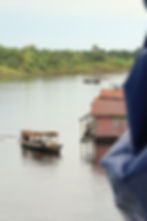
We were delayed with a few hours and eventually arrived at 5pm. We took a shortcut so did not cross the most well-known point where the two rivers – the Amazon and Rio Negro (Black River) – meet, known as the Meeting of the Waters, but we still saw it. The density of the two rivers is very different and so the waters do not mix, creating a clearly distinguishable boundary between the brownish water of the Amazon and the black water of Rio Negro.
For more information on where to go in Manaus and where to get tickets for boats from Manaus to Santarem, check out my other blogpost.
The people that made this boat trip unforgettable
In fact, the people that I met on the boat – and on this larger journey to cross the Amazon rainforest by boat and bus in general – were one of the main reasons that made this trip unforgettable!
In the line at the ticket counter, I met two other backpackers – a German backpacker called Leoni and a Mexican backpacker called Daniel. After a brief conversation we decided to hang up our hammocks next to each other. That night while I was brushing my teeth, it started storming heavily. Leoni joined and we ended up brushing our teeth for over ten minutes because the lighting was so stunning to watch! We then went to get Daniel and sat on the covered part of the boat's rooftop for over an hour, watching large flowers and trees of lightning shoot through the sky, closely followed by loud thunder. The amount of times we screamed from excitement was absolutely heart warming. We were all so genuinely excited to sit and watch the storm. I right away felt like I had found my people.
Over the upcoming days, we had conversations about life and where we are in each of our own journeys. We talked about masculinity and femininity, sexuality, creativity, freedom versus growing roots and stability, and many more topics. Leoni is a yoga teacher and did yoga every day. I joined her for one session with my own mat and each time she went there were more children showing up to do yoga with her – it was so cute!
On the first day, we also met a Peruvian traveller who had been on the road for over seven years. He was travelling with various musical instruments, including a charanga (traditional Peruvian guitar), a quena (Andean flute) and a maraca (shaker). The Indigenous women – they introduced themselves to me as Indigenous when I asked where they were from – that had helped me with my hammock had also brought two guitars. And Daniel is a singer. We ended up all playing together, singing and drumming with improvised drums (read: tupperware).
Our other neighbours had brought extension chords for the plugs which we could use, so we ended up keeping our phone in the side of their backpack as it was charging over their heads.
On the final day, I met one other backpacker from the United States and I came across the guy that I had seen but not spoken to at my hostel in Iquitos who is travelling the Americas with his motorbike. I had seen him around on the boat but he had always seemed busy with work, but on the last day then I finally spoke with him. He ended up joining our little crew, even moving his hammock to hang next to us for the final night.
My favourite part about travelling is connecting with humans and hearing about their philosophy of life. How amazing is it that there are so many different lives that cross paths on a slow boat in the middle of the Amazon rainforest!?
Other Frequently Asked Questions (FAQs) and tips
Some of these questions I already answered above, such as about the difference between the slow and the fast boat, whether to buy your ticket in advance, and safety on the slow boat. The other frequently asked questions are below. If you have a question that is not answered here, please send me a message via Instagram and I will see if I know the answer!

What is the food like on the slow boat from Tabatinga to Manaus, Brazil?
With regards to the food, on the first night on the slow boat we were apparently relatively late in line and so they had run out of rice and the only other option was meat…?! Leonie and I – already slightly feeling like stereotypical blonde, kombucha drinking, yoga girls – went on a little adventure to find vegetarian options on the boat. We were sent from eating area to the bar selling food upstairs back down to the eating area and then down to the kitchen. There were no vegetarian options but we eventually could order an egg sandwich upstairs for 6 BRL.
Luckily, the other days there were more options. We did queue up early each time, keeping an eye out for when people started queueing, which seemed to be earlier every day. On the second day we were in line for lunch at 10:20am!? Crazy. If you queue too late though, they run out of things like fruit, salad or fish – the latter which we had only on the last day.
The breakfast had some fruits, a type of cake, hot dog and bread, and a very milky and sweet oats situation. Especially if you are vegetarian or vegan, I recommend bringing your own oats and making them overnight with some cinnamon, apple and nuts.


Except for the first day, the lunch and dinner were pretty much the same with rice, spaghetti, beans (with meat until they had, luckily for us, ran out of meat on the last day), and chicken or fish (fish we only had the last day because they had run out of meat), and some kind of salad. Again, the salad runs out early, so try being early in line if you value getting your vitamins in. I had brought a cucumber as a snack, which was nice. Since most days, Leonie and I were not being served protein, we kept the breads from the breakfast and ordered a fried egg upstairs for 3 BRL per egg to either put on the bread or stir through our rice.
In terms of drinks, they serve coffee with a ton of sugar for breakfast, and some chemically tasting multifruit drink during lunch and dinner – with water, some of the flavours are tolerable. There is drinking water, which I drank without filtering further and that was fine. I even brushed my teeth with the water from the sinks until we all realized that it was slightly brown and seemed to be poorly filtered river water.
I was fine until the very last day – which ironically was the first day I brushed my teeth with bottled water that also tasted horrible – when I experienced two hours of dizziness and throwing up once but then it was over. So not sure what that was about. I suspect either motion sickness because I was reading during a storm, or too much grease on the fried fish that I was not used to.
Altogether, in terms of snacks, I definitely recommend bringing some fruits, muesli bars, nuts, and oats. Sometimes vendors also come onto the boat to cell things like ice cream (Picolo, absolutely delicious. We bought them twice and two per person each time), mango, and açaí – the traditional one, so without sugar. Obviously, you can pay these vendors only in cash.

What are the bathrooms like on the slow boat?
Honestly, I had expected much worse. Somewhere else I had read that people did not shower for the full three days, so I had expected it to be really gross. But definitely it is nicer to shower in those showers than to stay sticky from the hot humidity for those days. Plus, Brazilians are very set on cleanliness and Europeans apparently are already known for smelling bad. So, maybe take that into consideration when deciding how often you shower ;)
The toilet paper sometimes ran out and the toilets were not always clean, but boat personnel cleaned them throughout the trip and the fact that the showers were in the toilet cabins I guess helped keep them clean too.
I brushed my teeth with the water from the sink, but if you have a sensitive stomach maybe do not do that.

Is there internet on the slow boat from Tabatinga to Manaus, Brazil?
Around the towns there is phone service and so if you use an e-sim like me, or have a local simcard, you can load your messages from time to time if you want. You can get an e-sim for Brazil from Yesim or from Airalo (you can use my friend code ILSE8196 on Airalo to get a discount on your first purchase there). There is also the possibility to buy internet on the boat. It costs about 70 BRL for the whole the three days, but Leonie got it and it is quite unreliable. So definitely do not depend on it for meetings, but if you like to stay somewhat reachable for friends and family, that is an option.
I however deeply enjoyed being offline for three full days. Besides the people that I met on the boat, that was the other part that made this journey so wonderful for me. I spent hours just looking at the trees outside, imaging all the life going on in the forest. On the first night, we experienced the best thunderstorm of my entire life which we watched as if watching a film in the cinema. I also spent hours listening to music, journalling and reading the downloaded books on my e-reader.


Can you charge your devices on the slow boat from Tabatinga to Manaus, Brazil?
Yes, there are plugs. Despite the slow boat being fairly simple, there is running water, electricity, the possibility to buy wifi, and so also the possibility to charge your phones. The amount of plugs are limited though and are found on the side of the boat, near the toilets or near the captain's cabins. Various locals who clearly take this journey more often take extension chords. Our neighbours had done so and we constantly asked if we could charge our phones with them, even putting our phone in their backpack while charging to not let it hang.
How much do you spend on the slow boat from Tabatinga to Manaus, Brazil?
One ticket for a hammock spot on the slowboat from Tabatinga to Manaus costs 120 BRL (20 EUR) and includes three meals per day. If you eat meat and are okay with the food that is served on the boat, then in theory this is all you need to spend for three nights and four days alongside a hammock which you can get for roughly 30 BRL and extension chords for 10 BRL.
On Maho on Earth, I read that they paid 60-70 EUR for the shortest distance hammock space in 2019 and that their cabin cost 170 EUR on the boat from Tabatinga to Manaus. Not sure if it used to be more expensive, but if they charge you this now for a hammock spot then you are definitely getting scammed! If you are doubting whether you are getting scammed, then it is best to buy your ticket at the official ticket office at the port.
Since I eat vegetarian and was missing my proteins, I bought two eggs each day, which added another 6 BRL (3 each) per day. I also got a few sodas (on the boat), ice creams and açaí from vendors, and bought some snacks in advance (fruits, cucumber, biscuits, muesli bars and nuts). There is a special tap with potable water on the boat, so no need to bring water. Altogether, for snacks on the boat and in preparation for the boat I spent maybe 70 BRL total.
If you want you can buy internet on the boat for 70 BRL for the whole three days, but I would recommend logging off for a few days. At the larger towns on the way, you might pick up on cell service if you have an e-sim. Via Airalo you can use my friend code ILSE8196 on Airalo to get a 3 EUR discount on your first purchase.
So for three nights and four days, I spent less than 200 BRL (30 EUR) to get from Tabatinga to Manaus per slow boat. That is of course excluding tuktuks and taxis from and to the port and my stay at hostels in Leticia and Manaus.

Is it worth it to take the slow boat from Tabatinga to Manaus, Brazil?
Obviously this question depends on your style of travelling, but as a slow travelling, solo female backpacker that is good with the basic level of comfort that comes with budget travelling: I can absolutely 100% recommend taking a slow boat in the Amazon rainforest.
I only took the slow boat from Tabatinga to Manaus and did the rest of my trip per fast boat. If I had had more time, I would have done at least one more slow boat but – as you might know from my other articles in this series on Crossing the Amazon Rainforest by Boat and Bus I had the illusion that I was able to arrive from Peru to Suriname in less than two weeks to be in time to celebrate New Year's with my family. That did not work out, but even with taking mostly fast boats, my trip was an unforgettable adventure.
I stayed in at a hostel in Iquitos and at a hostel in Leticia various days, I ended up being stranded in Alter do Chão – known as the Carribbean of the Amazon with white beaches – for over a week, and I couch surfed in French Guiana. I also met wonderful people and heard various inspiring travel stories of avid travellers that definitely go off the beaten path.
Final thoughts on travelling from Tabatinga to Manaus by boat
Whether you take slow boat or fast boat and whether you go only from Tabatinga to Manaus or decide to cross the entire rainforest by boat and bus: it will be an adventure and surely a travel story worth telling after!
Thank you for reading and if you have any other questions or information that I missed that could help fellow travellers, please let me know via Instagram!


