


Travel by Boat from Iquitos to Santa Rosa and Tabatinga - Crossing the Amazon Rainforest in Peru (2026 Guide)
- Ilse

- Feb 21
- 18 min read
Updated: Mar 7
Have you ever looked at a map of the Amazon and wondered what it actually takes to move through it without flying? In the Peruvian Amazon, boats are public transport and the river is the highway. From Iquitos, the largest city in the world without road access, the only way forward is by river.
In this post, part of my series Crossing the Amazon Rainforest by Boat and Bus, I share exactly how to travel from Iquitos to the border town of Santa Rosa, and how to continue onward to Leticia (Colombia) or Tabatinga (Brazil). I’ll cover the different boat options, what they cost, how long they take, and how the border crossing actually works - the practical details I was looking for myself before making this journey.

Contents of this blogpost
Why travel from Iquitos to Santa Rosa by boat?
Boat options from Iquitos to Santa Rosa
Where and when to buy tickets for the boats?
My experience on the boat from Iquitos to Santa Rosa
How to cross the border from Santa Rosa to Leticia (Colombia) or Tabatinga (Brazil)
Step 3 – Enter Colombia (or Brazil)
Taking out money in Leticia (Colombia) or Tabatinga (Brazil)
Should you stay in Santa Rosa (Peru), Leticia (Colombia) or Tabatinga (Brazil)?
Frequently Asked Questions (FAQs) about the boat from Iquitos to Santa Rosa
How long does it take to get from Iquitos to Santa Rosa?
How much does the boat from Iquitos to Santa Rosa cost?
How do I buy tickets for the boat from Iquitos to Santa Rosa?
Is the Iquitos to Santa Rosa boat safe?
What should I bring on the boat from Iquitos to Santa Rosa?
Is there an ATM in Santa Rosa?
What is the best time of year to travel from Iquitos to Santa Rosa?
Can I cross from Santa Rosa directly to Tabatinga (Brazil)?
Do I need a visa to cross from Peru to Colombia or Brazil at Santa Rosa?
When is it not necessary to stamp in and out of Peru, Colombia or Brazil?
Other posts in this series
Crossing the Amazon Rainforest by Boat (overview post from Peru to Suriname)
How to travel by boat from Yurimaguas to Iquitos, Peru
How to travel from Tabatinga to Manaus with the slow boat
Travel by boat from Manaus (AM) to Santarém (PA) to Macapá (AP), Brazil
If they are not linked yet, that means I am still writing them. I will publish them in February and March in 2026. Sign up for my newsletter to get notified!
Why travel from Iquitos to Santa Rosa by boat?
Santa Rosa is one of the main border towns in the Peruvian Amazon and is relatively easily accessible from Iquitos, which is considered the largest city that is not connected by roads. This also means that the way to go to Santa Rosa is by boat. The river is quite literally the highway here and hundreds of people are on it every day.
During your boat ride, you will pass riverside villages, floating houses, locals in small boats travelling between villages and fields, fishers, and endless stretches of rainforest. Whether you take the fast boat or the slow cargo boat, the journey itself is part of crossing the border and one of the more authentic travel experiences you will probably have! Taking the trip from Iquitos to Santa Rosa by boat means you are moving through one of the most remote regions in South America in the only way it’s historically been possible.
Boat options from Iquitos to Santa Rosa
There are two types of boats going to Santa Rosa from Iquitos: the slow boat which takes three days and leaves when full and the fast boats that leave according to a set schedule and arrive the next morning.
Slow cargo boat (Lancha)
If you have time (and patience), the slow cargo boats from Iquitos to Santa Rosa take 2–3 days (48–72 hours) depending on river conditions and cargo loading. Prices usually range between 100–140 PEN, which often includes three very basic meals per day - typically rice with chicken or fish, plantain, and sometimes lentils. You sleep in a hammock on a covered public deck alongside locals, families, traders, and cargo (sometimes apparently even chickens). You need to bring your own hammock, ropes (to hang up the hammock), and snacks.
I am not sure about the availability of water on the boat, but surely there will be vendors at some of the stops whom you can buy water from. I have a filter water bottle from Grayl, which I can also recommend.
There is no fixed departure schedule - boats leave when they’re fully loaded. It’s hot, noisy and slow, but probably also one of the most immersive ways to experience the Amazon River beyond tourism infrastructure.
I did not take this slow boat, I only took a slow boat with hammocks between Tabatinga and Manaus, but someday I would like to do a slightly different trajectory (crossing the Amazon through Colombia) and take this one too.
Fast boat (Lancha rápida)
I took the fast boat from Iquitos to Santa Rosa as I wanted to arrive before Christmas. So, when I was in Iquitos in December 2025, I looked at all the different fast boat options to compare them. Essentially, there are two companies that have fast boats from Iquitos to Santa Rosa and the prices differ significantly.
The most expensive option is Ferry Amazonas. This boat is supposedly more luxurious than Zoe Alexa, which I will discuss in a bit, and has multiple floors. The lowest floor is only available for Peruvians and costs 80 PEN. Foreigners are obligated to buy the upper floor seats, locals can opt for that one if they want more luxury. For locals the price for the upper floors is 250 PEN and for foreigners 300 PEN. There is a service fee of 8 PEN coming on top of that. One meal is supposedly included and I have heard there are water and cookies. From the photos, the chairs seem to be slightly wider and some seats share a table.
This boat company is run by the government and is offered cheaper to locals to facilitate transport between local villages in a faster and more comfortable way, so that is quite nice.
It leaves every day from Puerto de Iquitos ENAPU, which is a nice port in the sense that it feels like the gate at an airport and from the photos seems to have airconditioning.
I doubted about taking Ferry Amazonas one because I still had to work on my paper while on the boat - impeccable timing, I know, digital nomad life was digital nomading haha. I am so happy I didn’t though because the other option, Zoe Alexis, was very comfortable and I could easily keep my laptop on my lap.

Zoe Alexa is the cheapest option and the one that I would recommend. It costs 120 PEN and leaves at 5pm, which means gathering at the port at 4pm. It leaves from Puerto Ganza Azul and goes every other day. I went in holiday period, so there was an adapted schedule.
If you have read about my boat journey from Yurimaguas to Nauta, this boat was so much more comfortable than that one! I had a lot of leg space, the boat ride was much less bumpy as the boat was bigger, and one meal was included. That meal had meat, however, so I did not take it.
On Zoe Alexis my data did not work, I think you can buy wifi for 10 PEN for the journey. On Ferry Amazonas I assume that is included. Both boats will say they take about 12 hours, but in my experience with all the boats I took through the Amazon rainforest, they always take longer. With Zoe Alexis I left at 5pm and arrived around 8am the next morning, so it took 18 hours.
Here are some (horrible photos) of info sheets with phone numbers, email addresses and schedules of the boat companies.


Where and when to buy tickets for the boats?
For both the fast boats, you can buy tickets at the offices which are in the city center. The office from Ferry Amazonas has recently moved and so its new location is not yet on Google Maps, or at least it was not in December 2025. It is on Condamine, I have linked the Google Maps location pin of the new Ferry Amazonas office here. The office from Zoe Alexa is only a few blocks away.

I booked my ticket a day in advance and even with the holiday season and many people travelling, there was still plenty of space on Zoe Alexa. I even had a whole row to myself so could fully lie down to sleep! Ferry Amazonas told me there were only a few seats left. I am assuming that because Ferry Amazonas is set up for fast transport in between villages that many locals choose that one both because it is cheaper, or because it is the only one going to their village.
Slow boat tickets are usually bought in person at Puerto Masusa in Iquitos, either directly from the boat operators or via small offices near the port. Unlike in Brazil, I have not found a reliable online booking system. It’s best to go to the port one day before you want to leave and ask around about departures to Santa Rosa. Boats don’t operate on fixed timetables but instead leave when cargo is fully loaded, which can mean delays of several hours or even a day. This is different from Brazil, where boats do have set schedules! Bring small bills in cash (PEN). And if you want a better hammock spot, arrive early on departure day.
My experience on the boat from Iquitos to Santa Rosa
Like I said above, I took the fast boat because I was somewhat pressured with time as I was trying to cross the entire Amazon to get to Suriname by new year's (spoiler alert: I failed, but in divine ways). So, my experience here will be focused on my journey with Zoe Alexa.
I did take a slow boat from Tabatinga to Manaus and have shared my experiences in another post. Note that the slow boats in Brazil appear to be quite different from the ones in Peru though - the ones in Peru are generally cargo ships where hammocks are tolerated, whereas the ones in Brazil carry cargo but also have entire floors solely for hammocks.
Alright, onto the journey from Iquitos to Santa Rosa. From my hostel in Iquitos, I took a TukTuk for 7PEN to Puerto Ganza Azul. I thought this was quite expensive at first, but it turned out to be slightly further than I thought and it was hot so I did not want to wait around for another TukTuk to arrive to my hostel.
When arriving at the port, a guy offered to help me with my heavy bag. He put it all the way in the front of the line and I gave him the 3 PEN change from the TukTuk. I felt very awkward about being put in front of the line, so I waited until half the line had passed and then scooped in between.
When entering, people take your large luggage to put it under the floor of the boat or on front row seats. My carry-on backpack with laptop and other valuables I kept with me (and I always recommend you to do this - especially since this is a requirement for most travel insurances for valuables to be insured).
I secured a window seat and since the curtains were on the inside and I could open the window, I had fresh air and looked at the BEAUTIFUL starry sky at night. Some of the most stars I have seen in my life thus far!

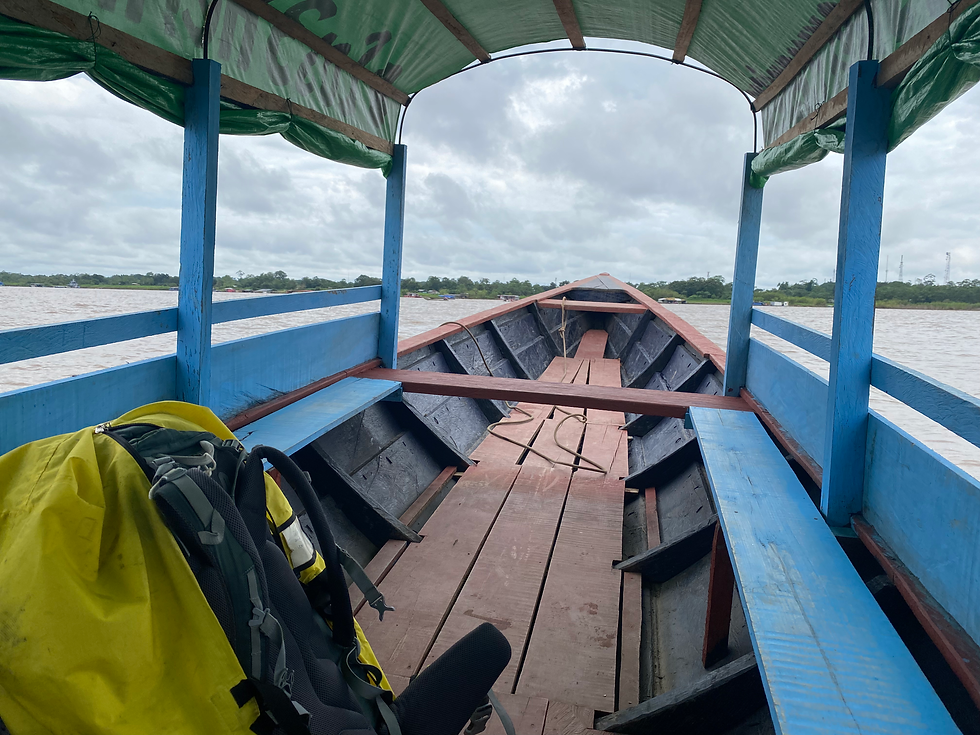
As with my other boat journeys through the Amazon, we passed various villages where people get on and off. For almost the entire journey, however, I had the entire row to myself, so I even got some vertical sleeping hours in. Altogether, the boat journey was calm, nice and fast and obviously I enjoyed the views of the river and the sunrise.
We arrived at Santa Rosa in between 8 am 9am after an 18-hour boat ride. It is important to remember when you arrive that if you continue to Colombia or Brazil, you should not follow the crowd to the ferry. Instead, you have to first stamp out of Peru at the immigration office in Santa Rosa. Most local travellers will do this because they continuously visit the border towns for work, family visits or shopping and since there is a 80km free travel zone around the border, they do not need to stamp in and out all the time.
How to cross the border from Santa Rosa to Leticia (Colombia) or Tabatinga (Brazil)
The border crossing from Santa Rosa to Leticia / Tabatinga itself only took a few hours in total, but my stay at the border before I continued my boat journey from Tabatinga to Manaus took a few days. So I will also include some bits on my experience of Leticia.
Step 1 - Exist stamp from Peru
As I said above, when you get off of the boat from Iquitos to Santa Rosa do NOT follow the crowd to the ferry right away if you are planning to stamp out of Peru.
The Immigration office is about a 10-minute walk from the port. I asked another backpacker called Flo if he knew where it was and he did, so we walked together. At the immigration office, I was sent to one of the next-door hotels to pay my fine because I had overstayed my visa with a few days. Paying the fine (of 5 PEN per day, so for my 8 days it was 40 PEN in total) was easy. I came back to the immigration office and they stamped me out.


Step 2 - Boat to Letica
After having been stamped out at the immigration office in Santa Rosa, I hitch hiked back to the port on the back of a water truck. On the way, I came across Flo walking (like I said, this town is really small)
. He joined me on the water truck and we stopped a bit early to get out at a local tienda for free hot chocolate and cake that was being handed out for Christmas (it was the 23rd of December).
There were also dozens of children lined up in front of a table with presents. It was cute to see and it was heartwarming how they people here welcomed us and and gave us not one but even a second cup of hot chocolate!

We then walked to the port from the tienda and on the way guy offered us his boat, initially for 10 PEN per person. Flo then said that usually the others charge only 5 PEN so we ended up paying 10 PEN for the both of us. The boat brought us to the port in Leticia, Colombia.
Step 3 - Enter Colombia (or Brazil)
Normally, at the port in Leticia there is an immigration office but when we were there it was closed for construction and so to stamp in into Colombia you had to go to the immigration office at the airport. However, there is a 80km free zone around the border, so since I was heading onward to Brazil, I decided to stamp into Brazil right away.
Note that you have to stamp into the next country within 24 hours of stamping out of the previous one. So, if you arrive late at night you can also do it early in the morning. The Brazilian Federal Police closes between 12PM and 2PM for lunch.
Before going to the Brazilian Federal Police, I dropped my bags at the hostel in Leticia where I would stay for three nights. I right away had service in Leticia because I had bought my e-sim in advance, which I do in most cases unless I am visiting a friend somewhere. You can get an e-sim for Colombia, Brazil or Peru from Yesim or from Airalo (you can use my friend code ILSE8196 on Airalo to get a discount on your first purchase there).
At the hostel, I asked how much it would be to go by tuktuk to the federal police, the ATM and the boat station to inquire about the boats. The hostel owners then recommended me to go with one of their trusted drivers since it can be unsafe to have a TukTuk driver know you are going to an ATM. So, I went on the back of a motorbike around Tabatinga and it was so fun! Absolutely something I would pay for even as a joy ride.
In Brazil, you get the stamp at the Federal Police station. It is a bit strange when you walk in as it is a very small space, and the officers are sitting behind a semi-dark window.
A funny little story about how it went for me: I did not say anything upon walking in as I was very confused, so the main officer got his colleague who spoke English (being tall and with blonde hair and blue eyes I am easily spotted as a foreigner). Then, after giving my passport and saying that I wanted to stamp into Brazil, I overheard them talk about whether I had paid the fine for previously overstaying a visa in Brazil (which I had). After I had explained in English and they were still discussing, I confirmed what they were saying in Portuguese and was reminded by how much I love Brazilians. “Você fala portuguê??” the main officer blurted out. The others who had been talking about me – nothing negative and I couldn’t hear everything anyway because of the window – quickly hid behind a window. It is always fun surprising people with a language they do not expect me to speak as a foreigner ;) But also good to know that they also speak English at this immigration office in case you have any questions and do not speak Portuguese. Altogether, I was outside again in a few minutes.
Taking out money in Leticia (Colombia) or Tabatinga (Brazil)
Although I would officially be staying in Colombia for a few days, I decided only take out Brazilian Reales (BRL) at an ATM in Tabatinga. In Leticia they accept BRL if you do not have Colombian pesos. They do not accept Peruvian Soles (PEN), so remember to spend them before you take the ferry from Santa Rosa.
I honestly never checked the conversion rates when paying for the hostel, TukTuk, and ice cream, so no idea at what point it becomes financially better to get out Colombian pesos.
Should you stay in Santa Rosa (Peru), Leticia (Colombia) or Tabatinga (Brazil)?
Santa Rosa is very small and does not have hostels, they only have (high priced) hotels. So, unless that is within your budget and sounds exciting to you, I do not recommend staying in Santa Rosa. Even if you arrive too late to stamp out of Peru, it will be cheaper to take the ferry to Leticia, Colombia and come back the next day within opening hours just to stamp out. As I said above, there is an 80km free travel zone in this border area, so you will not be doing anything illegal.

I looked at places to stay in Leticia and places to stay in Tabatinga and decided on Leticia mostly because the options were much nicer, there were more hostels and there were more cafés nearby. As I was driving through Tabatinga on the motorbike, I figured I had made the right decision as Leticia has much more of a cozy, small town feel and Tabatinga much more a border town feel.
In Leticia, I stayed in Janga hostel in Leticia for three nights, which I can recommend. When I was there the internet was slow as there were a lot of people around for Christmas, so I spent two afternoons working in a brightly colored gelateria called Nai Chi as that appeared to be the only ‘café’ option with good internet to finish my papers.
On Christmas Eve after finishing my paper and everyone else had left the hostel to celebrate, I was happily surprised that the internet was good enough to watch 5 episodes of Grey’s Anatomy without hiccups – honestly, the perfect way for me to spend Christmas Eve and wind down from days of night boats and paper writing.
I then took the first possible slow boat after Christmas, on the 26th of December, to travel from Tabatinga to Manaus.
Frequently Asked Questions (FAQs) about the boat from Iquitos to Santa Rosa
How long does it take to get from Iquitos to Santa Rosa?
Slow boats take three full days and two nights. You have to bring your own hammock to sleep on the boat. The fast boats take about 18 hours, you leave around 5pm in the afternoon from Iquitos and arrive the next morning around 8am in Santa Rosa. To get from Santa Rosa to Iquitos the durations are similar, but the departure times might be different.
How much does the boat from Iquitos to Santa Rosa cost?
The slow boat costs approximately 100-140 PEN. You have to buy a hammock in advance, which cost about 30 PEN. Make sure you check if they also give you the ropes to hang up the hammock. I bought my hammock in Yurimaguas for 30 PEN and only used it in Tabatinga, where I realized I did not have the ropes and so bought them for 10 BRL at the port.
The fast boats differ per company. Ferry Amazonas is the most expensive option and supposedly the more luxurious one. It costs 80 to 250 PEN for locals and 300 PEN for foreigners, you also pay a 8 PEN service tax. Foreigners can not stay on the more affordable floor because this boat service is specifically set up for people travelling between villages. Zoe Alexa costs 120 PEN for both locals and foreigners and is therefore the much better option if you are a foreigner. Remember that you have to pay in cash!
How do I buy tickets for the boat from Iquitos to Santa Rosa?
For the fast boats, you buy tickets at the office of the respective boat company. Both the offices for Ferry Amazonas and for Zoe Alexa are in the city center and nearby each other, so you can compare your options. However, considering the price difference and that Zoe Alexa is quite luxurious already, I would highly recommend Zoe Alexa.
I bought tickets about a day in advance. Make sure you check about the tickets a few days before you want to go because the boats do not go every day and sometimes alternate. You don't want to have to buy the more expensive Ferry Amazonas if you could have left a day early or later and wanted to go with Zoe Alexa. Note that you have to pay in cash!
Is the Iquitos to Santa Rosa boat safe?
On the fast boat from Iquitos to Santa Rosa I felt super safe. It was not too bumpy. I had my bag with valuables at my feet while my large backpack was in the storage space. I also charged my devices during some hours over night, although I always made sure to have them in sight, especially when the boat stopped and people went on and off. I also did not feel uncomfortable as a solo travelling female at any point, but that can depend on the people sitting around you. In my experience, it always helps to make some friendly contact with other women.

I have not been on the slow boat between Iquitos and Santa Rosa but have taken a slow boat from Tabatinga and Manaus and can imagine that the same safety precautions apply: on that boat I felt super safe and had made friends at the port with whom I hung up my hammock. Still, however, I slept with my small valuables (such as passport, phone and money) in my hammock and had my backpacks nearby. Both slow and fast boats will stop various times along the way and people will get on and off, so those are the main moments you want to keep an extra eye on your belongings. However, most people on the boats are very friendly, let you charge your devices at the charging point near them or they ask you if they can. So, there is a very nice atmosphere and I feel like people keep an eye out for each other.
However, as always applies where ever you are travelling (perhaps with the exception of Scandinavia), do not show your valuables if not necessary, try to follow what the locals do, and always trust your intuition - especially as a solo female traveller.
What should I bring on the boat from Iquitos to Santa Rosa?
For the fast boat, bring a light sweater (airflow at night can get cold), water, snacks, earplugs, and keep valuables in a small daypack with you. For the slow boat, you must bring a hammock, ropes, mosquito net, enough drinking water, snacks, and something to pass the time (downloaded podcasts, books, etc.). Cash in PEN is essential, especially if you want to buy snacks from vendors that come onto the boat. On the slow boat that I took from Tabatinga to Manaus there was nearly always toilet paper, but it can always be useful to bring some just in case.
Is there an ATM in Santa Rosa?
Santa Rosa is very small and does not have reliable ATM access. It’s best to withdraw cash in Iquitos before departure. In Leticia (Colombia) and Tabatinga (Brazil), you’ll find ATMs more easily, though machines occasionally run out of cash during busy periods like holidays.
What is the best time of year to travel from Iquitos to Santa Rosa?
Boats run year-round, but river levels vary. During high-water season (roughly December to May), travel can be smoother and boats may move faster. In low-water season (around July to October), journeys can take longer due to sandbanks and slower navigation. Rain is possible at any time of year in the Amazon. Keep in mind that if you go during the holiday season in December, boat schedules might change and boats run less frequently or are more quickly fully booked as people travel to visit family or do shopping across borders.
Can I cross from Santa Rosa directly to Tabatinga (Brazil)?
No. Even though the towns are very close geographically, you first take a small boat from Santa Rosa (Peru) to Leticia (Colombia), which takes about 10 minutes. From Leticia, you can cross by land to Tabatinga (Brazil), as the two towns are directly connected by road with no physical border barrier.
Do I need a visa to cross from Peru to Colombia or Brazil at Santa Rosa?
Most European, US, Canadian, and many Latin American passport holders receive a tourist visa on arrival for Peru, Colombia, and Brazil (typically 90 days, though Brazil can vary depending on nationality). You must stamp out of Peru before entering Colombia or Brazil if you plan to travel beyond the 80 km border zone. Always check official immigration websites before traveling, as visa rules can change.
When is it not necessary to stamp in and out of Peru, Colombia or Brazil?
If you do not plan to travel further than 80km away of the border and come back to the country where you are officially located according to your passport stamp history, you do not need to pass the immigration offices. Do remember to count the remaining days on your visa. For most European visitors Peru, Colombia and Brazil have a tourist visa on arrival for 90 days.
Final thoughts on the boat journey from Iquitos to Santa Rosa
Crossing from Iquitos to Santa Rosa is special experience, regardless of whether you choose to take the fast boat or the slow boat. It is not at all tailored to tourists, instead you are moving through the Amazon the way people here actually do: by river. It requires a bit of flexibility, some patience, and a willingness to let go of strict schedules. But if you’re crossing the Amazon overland, this stretch between Peru, Colombia, and Brazil is one of the various memorable parts of the journey and one that literally knows no alternative!
Thank you for reading and if you have any other questions or information that I missed that could help fellow travellers, please let me know via Instagram!


Comments