


Festa de Iemanjá in Salvador: Celebrations in Rio Vermelho can give a Preview for Carnaval in Salvador in 2026
- Ilse

- Feb 1
- 8 min read
Updated: Feb 21
I first arrived in Salvador years ago on my way from Praia do Forte, Bahia and ended up returning again and again, accumulating almost six months in the city over different stays. Long enough to stop seeing it as a travel destination and start experiencing it as a home and a place that shapes your nervous system. Salvador has a particular energy and meets you with rhythm, culture, heat, spirituality, and joy—often all at once.
Part of what kept me coming back was my cultural anthropological interest in the variety of cultures and religions that meets in Salvador and influences its cuisine, its music, and religious landscape. Salvador’s religious landscape can’t be separated from its history as the first colonial capital of Brazil and one of the main ports of the transatlantic slave trade. For centuries, people from different regions of West and Central Africa were forcefully brought here, carrying with them cosmologies, rituals, rhythms, and ways of relating to the world that survived despite violent attempts at erasure.
African religions were practiced in secrecy, disguised behind Catholic saints, woven into everyday life through music, food, healing, and celebration. What remains today is a living spiritual ecosystem that continues to shape how the city moves and celebrates.
Candomblé is one of the clearest expressions of this continuity. Rooted in Yoruba, Jeje, and Bantu traditions, it is a religion centered on the Orixás - forces of nature that are both archetypal and deeply personal. In Salvador, Candomblé is far from confined to terreiros or ritual spaces. Catholic saints coexist with Orixás, West African cosmologies live on in food, music, gesture, and rhythm, and belief isn’t something abstract or private. Candomblé is a religion of embodiment, relationship, and lineage, shaped by resistance and care, and still often misunderstood or marginalized despite its central role in Salvador’s cultural and spiritual life. This is particularly visible during the festivities of Iemanjá in Rio Vermelho.
The Festa de Iemanjá is celebrated in Salvador, Bahia every year on February 2nd in the neighborhood of Rio Vermelho. If you want to understand Salvador - not intellectually, but viscerally - this festival is one of the clearest entry points. And if you’re wondering whether Carnaval in Salvador is for you, from my friends I have learned that Iemanjá offers a surprisingly accurate preview...

Who is Iemanjá?
Iemanjá is the Orixá of the sea, motherhood, fertility, and protection. Her origins are West African, carried to Brazil through the transatlantic slave trade and preserved through Candomblé and other Afro-Brazilian religious traditions. In Salvador, African heritage is not a footnote but rather a foundation of the city and its culture. Did you for example know that Salvador is the city outside of the continent of Africa with the most Black African descent people?
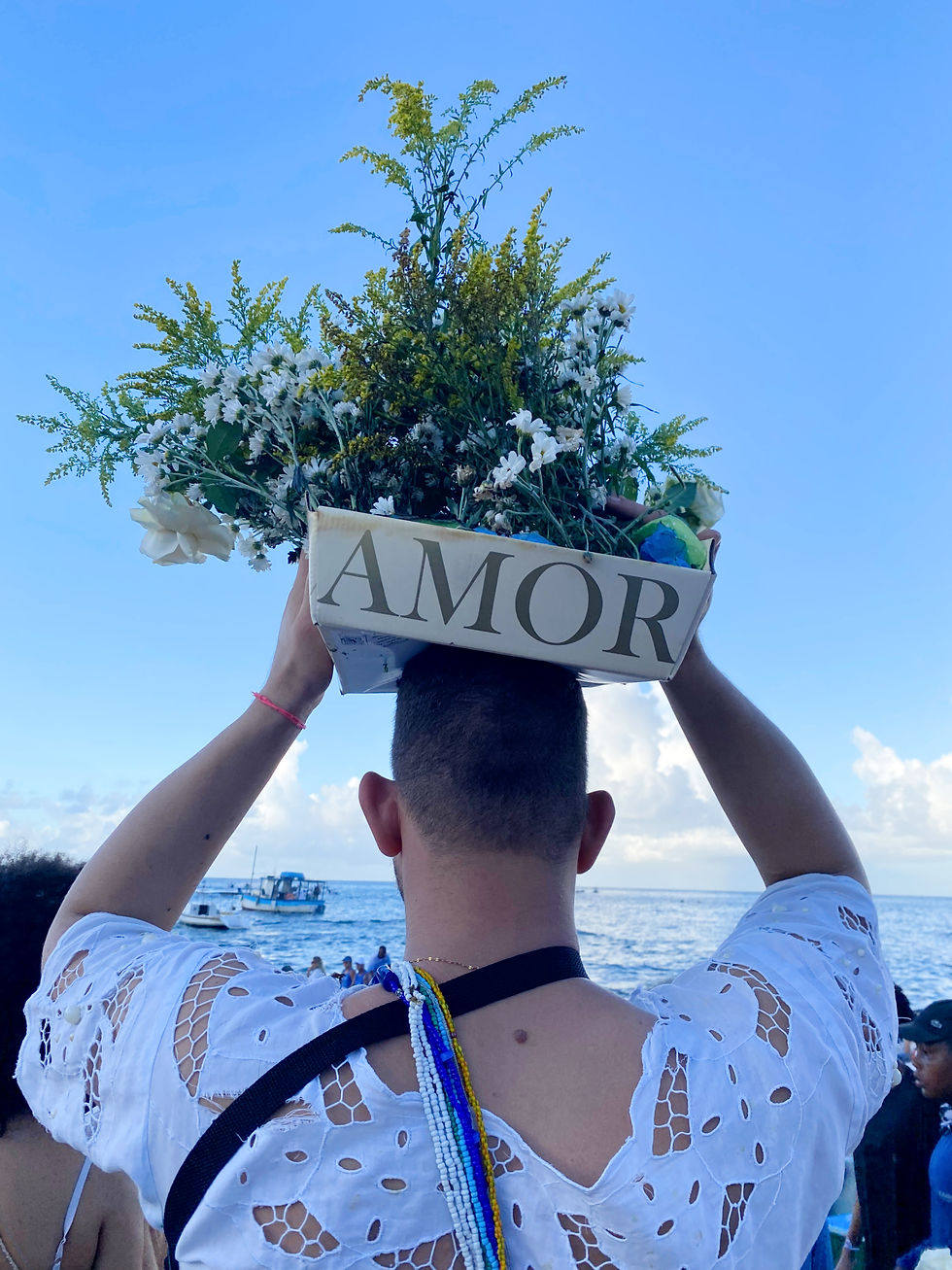
On February 2nd, people bring offerings to the ocean: flowers, perfume, mirrors, jewelry, handwritten notes. People are dressed in the colors of Iemanjá, which are white and blue. This is also the reason that people on the first of January, right after New Year's Eve, in Rio de Janeiro wear white and run into the ocean. The Festa da Iemanjá is celebrated on the first of January in Rio. The rest of Brazil, by the way, has taken over this tradition of wearing white even in places where there is no ocean and many people are unaware of the origins of this tradition that come from Iemanjá.
During the festivities, some come with deep religious devotion, others with curiosity, gratitude, or a quiet personal request they do not quite know how to articulate. In any case, in my experience at least, the energy of Iemanjá is tangible.
Visiting in Festa de Iemanjá in Salvador, Bahia
There is no single way to visit or participate in the festivities of Iemanjá in Salvador, and no clear line between observer and participant. You might arrive thinking you’re “just watching” and find yourself carrying flowers down to the water with strangers an hour later. Here is some information on how the day might go and where to be to experience this special energy!
Where is Festa de Iemanjá celebrated in Salvador?
The festival is centered in Rio Vermelho and takes place on the 2nd of February each year. Rio Vermelho is a seaside neighborhood that already has a strong social life year-round but transforms during Iemanjá. It also happens to be one of my favorite neighborhoods in Salvador and is a good place to stay for travellers and digital nomads, like myself.
The spiritual center of the festival is Praia do Rio Vermelho, near the Casa de Iemanjá, a small shrine dedicated to the Orixá. This is where many people bring their offerings into the water.

When does Festa de Iemanjá start in Salvador?
By early morning on February 2, the streets are already full. Stalls appear selling flowers and offerings. The smell of salt, sweat, fried food, incense, and perfume hangs in the air. Drums start early and do not really stop. Boats line the shore, ready to carry people and their offerings out to sea. People pray, dance, celebrate, cry, flirt (we are in Brazil, after all), and sing.
The Festa de Iemanjá technically starts very early. Before sunrise, devotees, fishermen, and members of Candomblé communities gather to prepare offerings and prayers. By around 5 to 7am, the first boats begin taking offerings out to sea.
Like I said, the spiritual center of the festival is Praia do Rio Vermelho. Here people bring their offerings - flowers, perfumes, handwritten notes - to be blessed and sent into the ocean. If you want to witness the most devotional, intimate side of the festival, this is the window to be there. You can buy flowers and for a few BRL you can take a boat onto the sea to make a prayer and let your flowers into the water.
As the morning progresses, the crowds grow and what begins as a ritual slowly opens into something broader and more social. By late morning and early afternoon, the streets of Rio Vermelho are full, and the energy starts to shift. Bursts of collective energy: singing, shouting, dancing, laughter fill the streets.
With that, the festival is sacred and loud at the same time - which for White Western travellers may seem a contradiction, but for most religions in the world is actually completely normal. I for example also experienced sacred and (very!) loud Hindu celebrations in Udaipur, India, and church ceremonies in Ghana that felt like a concert.
How (and Whether) to Participate to the Rituals of Festa de Iemanjá
There’s no requirement to do anything in a particular way. Some people come with very clear intentions and religious commitments. Others come out of respect, curiosity, or affection for the city. Participation can be as simple as being present.
If you do want to participate more actively, you can:
Buy flowers from street vendors and bring them to the water
Write a note or intention and place it with an offering
Wear white or blue, which many associate with Iemanjá
Stand quietly at the shoreline and observe
When I was there in 2025, I bought flowers and brought them to the water where I made a prayer to Iemanjá and the ocean, whom as a surfer and kitesurfer I respect very much.

In recent years, there has been increasing awareness around the environmental impact of offerings. Many practitioners now encourage biodegradable items only, avoiding plastic, mirrors, or objects that harm marine life. This actually includes the flowers that have been painted blue and in general flowers often contain a lot of toxins. I was not sure how to navigate this when buying mine from a street vendor, but if you can, try getting offerings are environmentally friendly.
The Festival part of Iemanjá (and when it starts to feel like Carnaval)
By mid- to late afternoon, the devotional core of the festival blends into something unmistakably Salvadorian: music and people dancing in the streets. Sound systems pop-up in the cafes on the main street and people start dancing in clusters that are difficult to navigate through.
This is where Iemanjá begins to resemble Carnaval - not in scale, Carnaval in Salvador attracted nearly 3 million people in 2025, but more in terms of intensity.
The closeness of people, the loud music, the way the street becomes a shared living room... It is intense! The difference between Carnaval and the afternoon festivities of Iemanjá is that the first overtakes the entire city and lasts for weeks. Iemanjá remains largely within Rio Vermelho and unfolds over a single day and night.
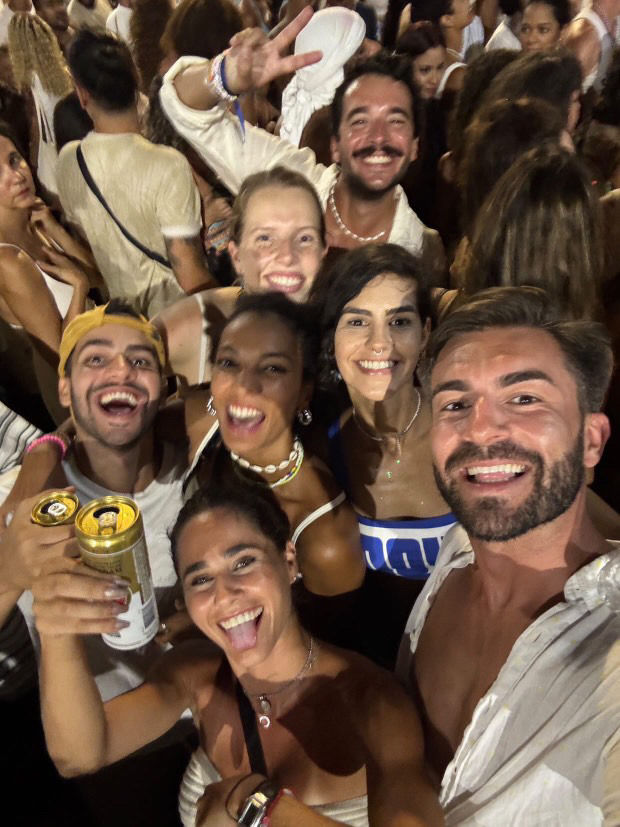
If you find yourself energized here - if the crowds feel alive rather than draining - it’s a good sign you might enjoy Carnaval in Salvador. If you feel overstimulated after an hour, that’s also useful information. I absolutely loved Iemanjá but got a little nervous about the intensity of Carnaval in Salvador and decided to spend that year's carnaval in São Paulo with a friend who lives there.
Is Festival part of Iemanjá safe?
I don't love putting this question as a seperate little heading in this post, but especially for gringo-looking travellers who are an easy target (like myself) this is worth a special mention.
In the morning on the beach, I was fine having my phone and some money with me. We took photos without problems, although you always have to be careful with that. In the afternoon, I went with local friends to the street festival part and purposefully did not bring a cellphone, wallet, or credit card. My friends had practically forbidden me to do so. And I was so happy with that decision!
Just like with Carnaval, for which safety of your belongings requires similarly rigid concerns, this is a street festival. That means that anyone can come and so there will be pickpockets. Even just walking through the crowd that afternoon, I could feel hands on and in my pockets - and those are the ones that I was aware of. Imagine the professionals that do it without you noticing. So, please do not bring valuables or keep them in a bag that you have underneath your pants.
Practical tips for visiting Festa da Iemanjá
A few things that make the day easier:
Go early if you want to experience the ritual side more clearly.
Expect crowds by late morning and throughout the afternoon.
Wear light (white or blue) clothing you don’t mind getting wet, sandy, or sweaty.
Bring as little as possible and keep your belongings secure. As I said above, there will be pickpockets.
Hydrate constantly because the heat of both the weather and all the people being close to you and the dancing will make you sweat.
Let go of rigid plans, the festival has its own rhythm.
Most importantly, don’t rush. This is not something to “cover” or cross off from a bucketlist. Cultural festivals like this are something that you move through and that hopefully you can allow yourself to be touched or even transformed by.
Why it stayed with me
What stayed with me after celebrating Iemanjá was the collective experience. I felt connected to the people around me, but also the ocean and it was a moment to connect more deeply with myself and give gratitude for my living my life so close by the oean. In a way, it reminded me a lot of how I experienced the Gangaur festivities in Udaipur, India. There too I felt connected with the women that had drawn me into a ritual by the waterside, but also felt connected to the deities that we were literally touching and the water that we were giving them to.
If you’re in the city on February 2nd then I can so recommend you to go. Move through it and let Iemanjá move you.
Thank you for reading and if you have any other questions or information that I missed that could help fellow travellers, please let me know via Instagram!


Comments